By Sharon Chimenya
MASVINGO — The government is dedicated to building a prosperous, industrialised Zimbabwe by driving forward social protection and sustainable development, in line with the visionary goals of the National Development Strategy 2 blueprint.
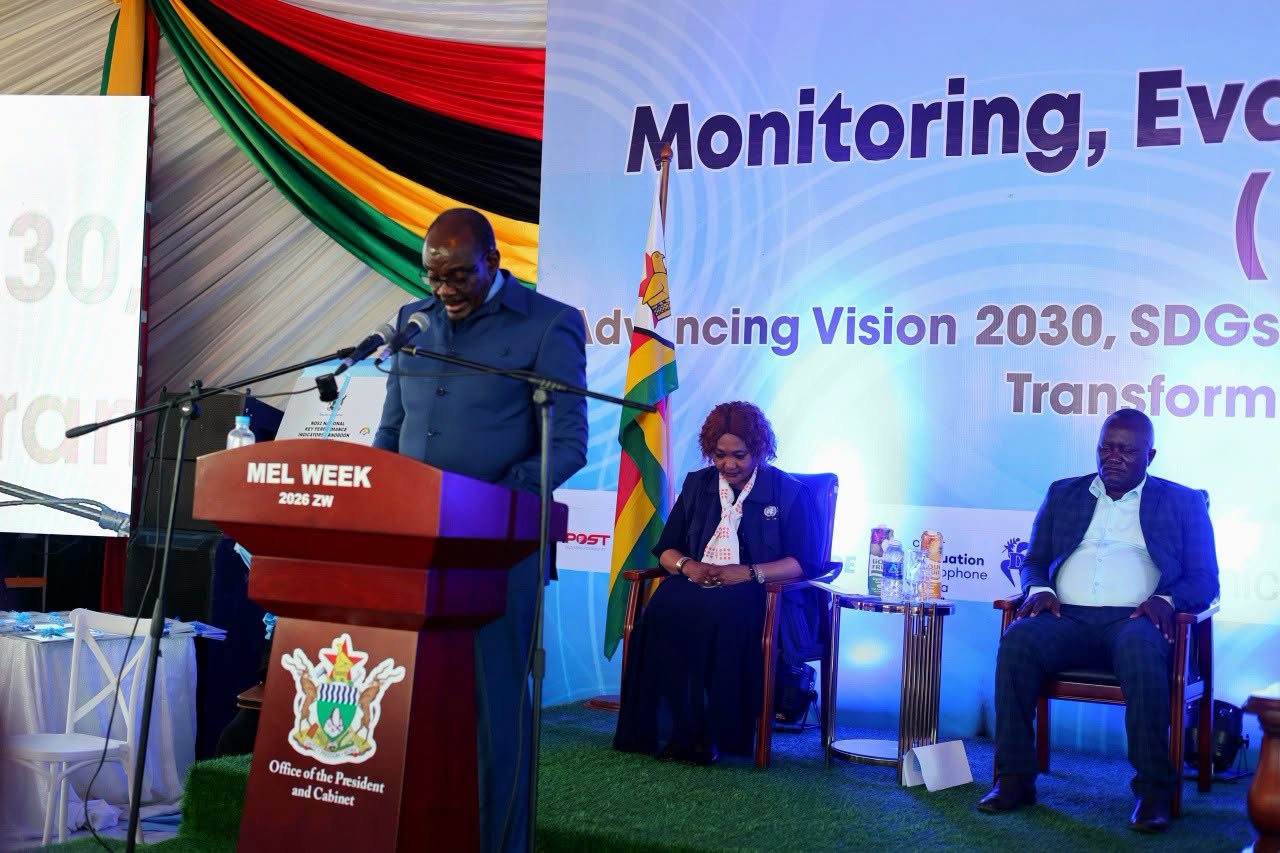
Speaking at the Monitoring, Evaluation and Learning (MEL) Week in Masvingo on Wednesday, Vice President Kembo Mohadi said the country is open for business for its own people and also for other nations.
The MEL Week was attended by government departments, academia, the private sector, and international delegates from South Africa, Tanzania, Kenya, Uganda, and the United Kingdom.
“In Zimbabwe, as we work to achieve Vision 2030 of becoming a Prosperous and Empowered Upper-Middle-Income Society, our public service delivery deepening becomes a vital cog in the transformative agenda. Speaking on behalf of His Excellency the President of the Republic of Zimbabwe, Dr E D Mnangagwa, the Second Republic is still dedicated to creating a rich, industrialised, and modern Zimbabwe,” he said.
“We are advancing social protection, infrastructure development, economic transformation, and governance changes under the National Development Strategy 2 (NDS2). You must all remember that Zimbabwe is Open for Business, for its own people and for other nations.”
He said one of the Second Republic’s top priorities is the devolution agenda, in which strengthened local MEL systems will empower communities, improve service delivery, and increase accountability.
Meanwhile, the Deputy Chief Secretary for Finance, Administration, and Human Resources, Zvinechimwe Churu, said citizens require tangible deliverables as they journey towards an upper middle-income economy, and that this is one of the challenges they are ready to tackle.
“As we intensify our collective efforts towards the realisation of Vision 2030, there are essential expectations from our citizens. At the heart of this journey is effective, inclusive, responsive, and transformative public service delivery. Zimbabweans expect tangible deliverables that translate into improved livelihoods,” he said.
“These include improved health delivery systems that are adequately equipped and stocked with essential medicines; trafficable roads; silos with grain; potable water; schools; and employment opportunities. A government that is people-centred, responsible, and accountable can meet these expectations. I have to add that this indeed is the challenge we are ready to tackle.”
Churu said the National Development Strategy 1 has shown great achievement in the implementation of transformative projects, and he called for an end to measuring performance solely by the deployment of resources. Instead, he advocated for a focus on monitoring, evaluation, learning, and data systems.
“Adaptive monitoring, evaluation, and learning systems, as well as data reforms, are new ways of conducting government business, with emphasis on evidence-based reports. Gone are the days when project and programme performance were based merely on the deployment of resources,” he said.
“The technical evaluation of NDS1 has shown great achievements in the implementation of transformative programmes and projects across all sectors of the economy. We must build on these achievements while learning from the gaps and challenges. MEL is where we link government policies to citizens and provide feedback on the execution of government plans.”
Special Advisor to the President on Monitoring Implementation of Government Programmes, Dr Joram Gumbo, said the theme at the MEL week speaks to the need to modernise the MEL systems which will enable decision makers to identify implementation challenges before they intensify.
“The theme, ‘Advancing Vision 2030, SDGs and Agenda 2063 through Public Sector Service Delivery, Transforming MEL and Data Systems,’ challenges us to modernise our MEL system for a public sector operating in an increasingly complex environment, where citizens rightly expect faster, more efficient, and more equitable services.”
“It serves as a reminder that our MEL system must be truly fit for purpose and must enable decision makers to identify implementation bottlenecks before they escalate into crises. While we have made significant strides, our MEL is far from complete. The next frontier is ensuring that evidence consistently informs decisions, decisions shape implementation, and implementation delivers tangible results. That is the core promise of MEL.”