

Staff Reporter
NEW YORK– The 2026 FIFA World Cup has already secured its place in football history even before Sunday’s final, with the expanded tournament rewriting the record books through unprecedented attendance, goals, individual achievements and historic firsts.
Co-hosted by the United States, Canada and Mexico, the tournament has become the biggest FIFA World Cup ever, featuring 48 teams and 104 matches following FIFA’s expansion from the traditional 32-team format.
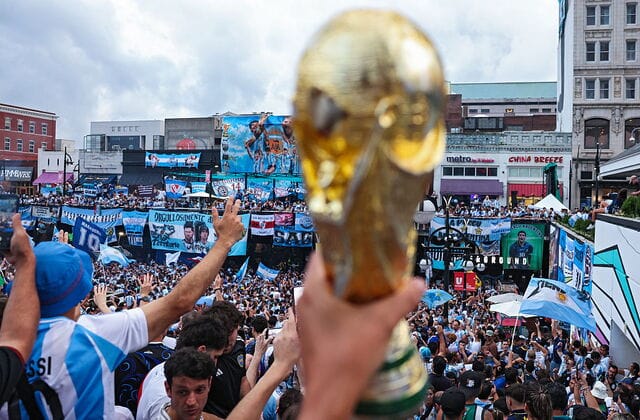
The enlarged competition has produced an avalanche of records, including the highest stadium attendance in World Cup history. More than 6.5 million fans had attended matches by July 15, eclipsing the previous record of 3.6 million set during the 1994 FIFA World Cup in the United States.
Goals have also flowed at a record pace. As we approach the final stages of the tournament, 297 goals had been scored in 102 matches, comfortably surpassing the previous World Cup record of 172 goals scored during the 2022 tournament in Qatar.
The expanded format also opened the door for new footballing nations. Curaçao, with a population of just over 150,000, became the smallest nation ever to qualify for a FIFA World Cup and the smallest country to score at the tournament.
Argentina captain Lionel Messi has once again dominated the headlines after breaking several long-standing individual records.
The 38-year-old became the first male footballer to feature at six FIFA World Cups and extended his record as the player with the most World Cup appearances, reaching 32 matches.
Messi also became the competition’s all-time leading goalscorer with 21 World Cup goals, surpassing Germany’s Miroslav Klose, who finished his career with 16 goals.
His remarkable campaign also saw him become the oldest player to score a World Cup hat-trick at 38 years and 357 days, while he also set a new record by scoring in nine consecutive World Cup matches across the 2022 and 2026 tournaments.
Portugal captain Cristiano Ronaldo added another milestone to his legendary career by becoming the first male player to score in six different FIFA World Cups. He also became Portugal’s all-time leading World Cup scorer with 11 goals.
France captain Kylian Mbappé continued to cement his reputation as one of world football’s finest forwards. He became France’s all-time leader in World Cup appearances with 21 matches, overtaking Hugo Lloris, while also emerging among the tournament’s leading scorers.
Norway striker Erling Haaland enjoyed one of the greatest World Cup debuts in history. Despite Norway exiting in the quarter-finals, Haaland scored seven goals in just four matches to become his country’s all-time leading World Cup scorer and joined an elite list of players with the most goals scored in a debut World Cup.
Spain also entered the history books after becoming the first national team to play six consecutive World Cup matches without conceding a goal.
The tournament also produced remarkable technical achievements. Mbappé recorded the fastest sprint of the competition after being clocked at 37.6 kilometres per hour.
Senegal midfielder Pape Gueye registered the most powerful shot of the tournament at 131.9 km/h, while Belgium’s Hans Vanaken scored the longest-range goal after finding the net from 32.45 metres against the United States.
With the World Cup final still to be played, more history could yet be written as football’s biggest tournament concludes one of its most memorable editions.
The 2026 FIFA World Cup will be remembered not only for crowning a new world champion but also for redefining what is possible on football’s grandest stage through record-breaking performances, expanded global participation and unprecedented fan support.