Harare (New Ziana) – African countries should not be complacent in the fight against HIV and AIDS as the pandemic remains one of the biggest threats to sustainable socio-economic development, President Emmerson Mnangagwa said on Monday.
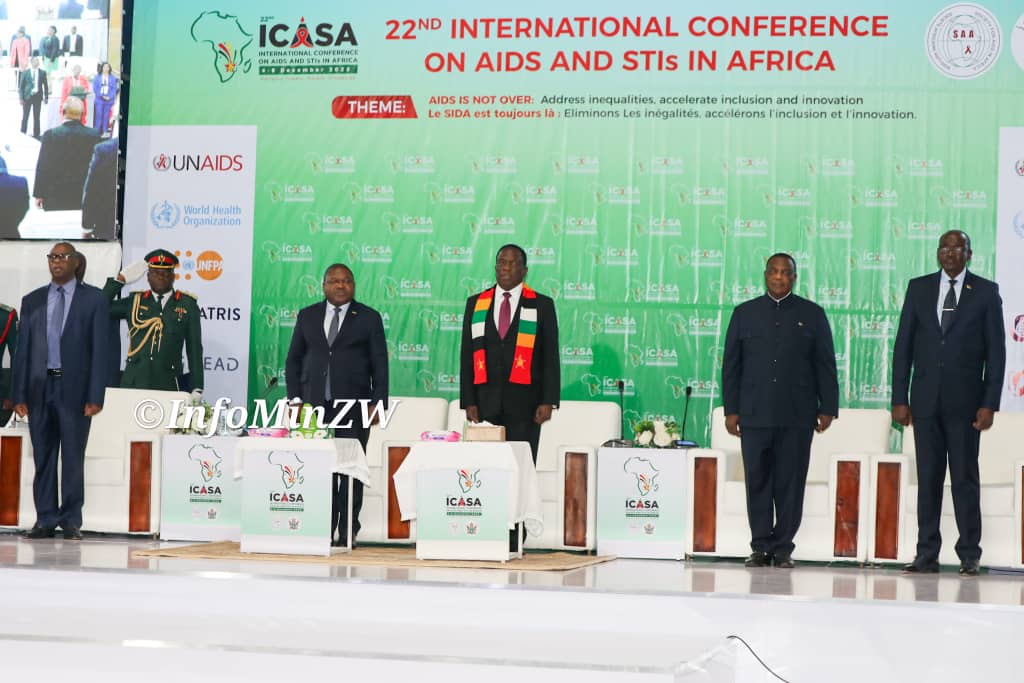
He said this while officially opening the 22nd International Conference on AIDS and STIs in Africa (ICASA) in the capital.
More than 5 000 delegates from over 150 countries are attending the six-day conference, which ends on Saturday.
President Mnangagwa said the 2022 report of the United Nations clearly shows that AIDS continues to claim lives and that is a call for continued action.
“Regrettably, new HIV infections continue to be prevalent among women, who accounted for 63 percent of all new infections, while new HIV infections among adolescent girls and young women, remain widespread in sub- Saharan Africa.
“It is encouraging that the Society for AIDS in Africa, have responded to the urgent realities of the time and ever-changing health environment. I, therefore, commend you for expanding the scope of the Conference to include discussions on key thematic areas such as pathways for Leadership in HIV and AIDS initiatives, building resilience and sustainable HIV prevention programming, along with other emergencies and epidemics,” he said.
He applauded several African countries, including Zimbabwe, for having already achieved the 95-95-95 fast track targets.
In December 2020, UNAIDS released a new set of ambitious targets calling for 95 percent of all people living with HIV to know their HIV status, 95 percent of all people with diagnosed HIV infection to receive sustained antiretroviral therapy, and 95 percent of all people receiving antiretroviral therapy to have viral suppression by 2025.
President Mnangagwa said the continent must harness the rich and diverse plant and animal endowment through the deployment of science, technology and innovation, to establish a vibrant African Traditional Medicines’ pharmaceutical industry.
“We must, as Africa, never shy away from building-on our rich African knowledge systems and God given resources to have scientifically viable medical products and solutions for our communities. Through such an approach, we should reverse the high disease burden and related mortality on our continent.
“As the people of this great Continent, we must build our respective countries and proffer the solutions needed to address our challenges.
Others from elsewhere should come to help and complement us, based on our own developmental priorities,” he said.
It is also critically important to ensure that both adolescent girls and boys as well as young women have unfettered and equal access to HIV services, he said.
He added that there is a need to address the HIV/AIDS pandemic holistically, including through addressing matters to do with guaranteeing food security and nutrition to communities beginning at the household level.
In view of the growing incidences of epidemics and conflicts, coupled with the negative impact of climate change, Presidentn Mnangagwa the Conference is most opportune as it allows reflection on the ongoing responses to HIV and AIDS at both the continental and global levels.
President Mnangagwa expressed gratitude for the opportunity accorded to Zimbabwe to host the conference for the second time, and said the government is fully behind consolidating the milestones achieved over the years.
The ICASA theme for this year “AIDS is Not Over, Address Inequalities, Accelerate Inclusion and Innovation” is a befitting reminder on the need to remain focused and avoid complacency, he said.
The United Nations has commended Zimbabwe for recording the highest decline in new HIV infections in Africa since 2010.
Mozambique President Filipe Nyusi attended the official opening ceremony.
New Ziana