
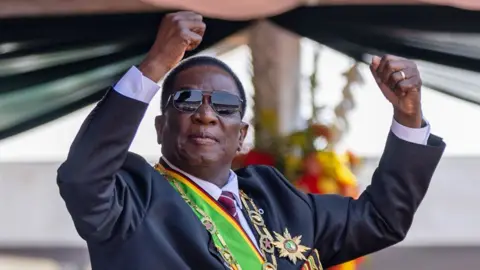
Maphisa, (New Ziana) – In an independence day national address, President Emmerson Mnangagwa on Saturday paid tribute to Matabeleland South Province for its pivotal role in Zimbabwe’s liberation struggle, describing the region as “sacred” in the country’s history.
Speaking in Maphisa where the main celebrations for the country’s 46th Independence anniversary were being held, he said the province was home to some of the most intense and defining battles of the war of liberation, citing areas such as Ratanyana, Zezani, Manama, Minda and Thekwane as key battlegrounds where ZIPRA forces confronted the colonial Rhodesian regime.
“Matabeleland South Province is of sacred significance in the history of our country. Many areas saw brutal, protracted and indeed defining encounters. These zones stand as haunting and yet heroic reminders of the cruelty suffered by our people,” he said.
President Mnangagwa said the province’s landscapes, mission stations and schools remain enduring symbols of unity and collective sacrifice, reflecting how Zimbabweans from all backgrounds came together to fight for independence.
He also highlighted that Matabeleland South produced some of the country’s foremost liberation icons, including the late Vice President Dr Joshua Mqabuko Nkomo, as well as national heroes such as Alfred Nikita Mangena, Lookout Masuku, George Silundika, Steven Nkomo and Simon Khaya Moyo.
“Their patriotism and selfless sacrifice for our motherland remain a source of inspiration to us all. We thank Matabeleland South Province for giving our nation many gallant heroes and heroines who helped liberate our land from colonial bondage,” he said.
President Mnangagwa further said the country continues to honour both fallen and surviving liberation war veterans whose sacrifices secured independence, freedom and democracy.
Turning to the economy, he said Zimbabwe had registered commendable growth under a stable macro-economic environment, with foreign currency reserves exceeding US$1.2 billion and inflation declining to single digits.
“The country has registered commendable growth under a stable macro-economic environment, with foreign currency reserves exceeding US$1.2 billion and inflation declining to single digits,” he said.
In the agriculture sector, President Mnangagwa noted that the country had recorded a successful season, producing 2.4 million tonnes of maize and significant volumes of traditional grains, ensuring national food security.
He said ongoing initiatives such as the construction of modern grain silos and climate-proofing agriculture were strengthening resilience, while Government mitigatory programmes would ensure no community faces hunger despite climate-related challenges.
He also outlined progress in mining, infrastructure development and social services, including road rehabilitation, dam construction, rural electrification and the upgrading of health facilities.
“The Second Republic’s rural development model, anchored on village business units and agricultural initiatives, was transforming livelihoods and boosting incomes across provinces,” he said.
On youth and employment, he said government was expanding skills training and creating opportunities to curb migration, particularly in provinces such as Matabeleland South.
“Government is expanding skills training and creating opportunities to curb migration, particularly in provinces such as Matabeleland South.
“There is need for collective action against drug and substance abuse, (and I am) urging communities to support rehabilitation and awareness programmes,” President Mnangagwa said.
He reaffirmed government’s commitment to improving healthcare, education and housing delivery, while strengthening devolution and local governance systems.
He further highlighted growth in tourism, which recorded a 10 percent expansion in 2025, and noted Zimbabwe’s recognition as a top global travel destination.
The country attained independence in 1980 after a protracted liberation struggle against British colonial rule.
New Ziana