Addis Ababa, Ethiopia (New Ziana) —African countries should transform shared river systems into engines of cooperation and regional integration and not sources of tension, as fragmented water governance is undermining the development prospects of the continent, an official said.
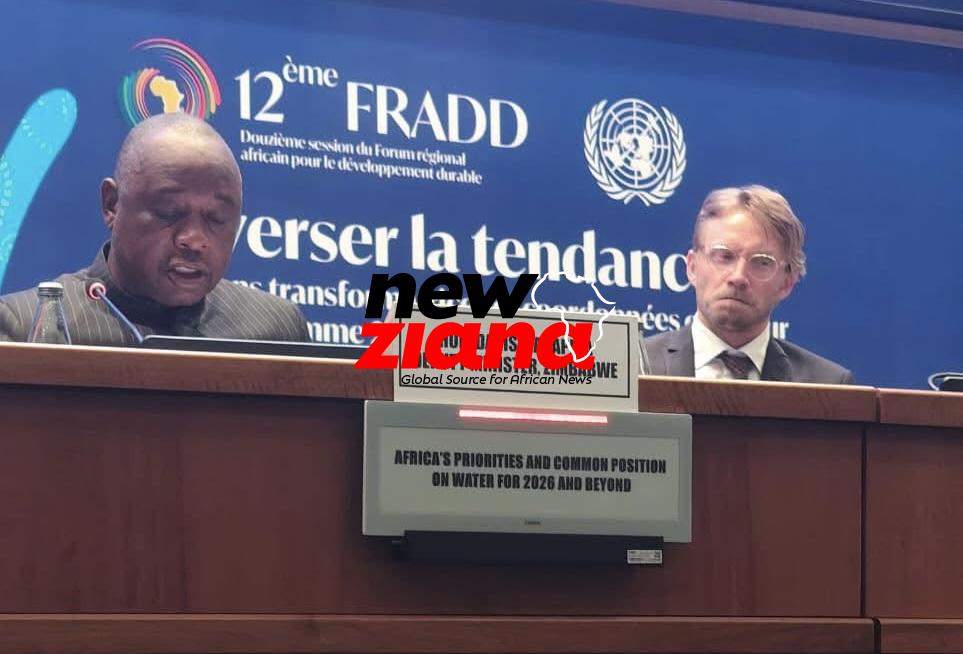
Deputy Minister of Agriculture, Davis Marapira, said this on April 27 this year while speaking at a high-level United Nations pre-event on shaping Africa’s common position on water, ahead of the 2026 UN Water Conference.
He said the continent’s vast transboundary water resources should be managed cooperatively to unlock their full socio-economic potential.
“Water does not recognise borders. Africa is home to 63 transboundary river basins covering 60 percent of the continent and supporting hundreds of millions of people. Yet these shared waters are governed by suspicion rather than solidarity,” he said.
The meeting, held at the United Nations Conference Centre in Addis Ababa and co-organised by the United Nations Economic Commission for Africa, the African Union Commission and the African Ministers’ Council on Water, brought together Ministers and water experts from across the continent.
Marapira warned that recent climate shocks, including the 2023–2024 El Niño episode, had exposed the limitations of country-specific responses to water crises.
“In a climate-stressed world, no single country can respond to regional water challenges alone,” he said, urging African states to adopt coordinated and inclusive water governance systems.
Drawing from Zimbabwe’s experience as a riparian state in the Zambezi, Limpopo, Save and Buzi river basins, Marapira said regional cooperation frameworks had delivered tangible benefits in flood preparedness, data sharing and environmental management.
He cited the country’s participation in the Zambezi Watercourse Commission, Limpopo Watercourse Commission and Buzi-Pungwe-Save Water Commission as practical examples of how shared water resources can be managed effectively.
“Zimbabwe’s experience shows that effective transboundary cooperation is achievable. We offer our frameworks and commitment to inclusive water governance as a contribution to Africa’s collective journey,” he said.
Marapira outlined a five-point framework to guide Africa’s common position, including strengthening legal instruments governing shared waters, expanding participation to communities and women, investing in real-time data systems, securing sustainable financing for river basin institutions, and elevating water diplomacy within African foreign policy.
He stressed that water security was central to Africa’s industrialisation ambitions, saying mineral-based value chains and agricultural productivity would remain constrained without reliable water systems.
“As Africa advances its industrialisation agenda to drive structural transformation and job creation, water emerges as a critical enabler,” he said.
The discussions took place alongside the 12th session of the Africa Regional Forum on Sustainable Development, which is assessing progress toward the Sustainable Development Goals amid growing concern over slow implementation.
With less than five years to the 2030 deadline, Africa is still lagging on most targets, including Goal 6 on clean water and sanitation, where hundreds of millions remain without access to basic services.
Marapira implored the continent to adopt a focused and action-oriented approach.
“Africa’s common position must be disciplined and focused, not a catalogue of issues, but a set of non-negotiable priorities linked to real investments and measurable impact,” he said.
“Let us protect water, govern it wisely, and ensure it flows equitably for every African today and for generations to come,” he added.
New Ziana