By Maxwell Mapungwana
Harare, (New Ziana) — At first glance, Nzvimbe Business Centre under Chief Chiduku in Manicaland Province appears like any other remote rural outpost — quiet shops lined along dusty roads, villagers going about their daily routines, and school children wandering around after classes.
But beneath the calm atmosphere lies a community on the cusp of transformation. On a recent visit to the business centre during a Rural Electrification Agency (REA) switch- on ceremony, a striking scene captured the essence of what electricity means to many rural Zimbabweans.
A crowd of primary school children squeezed tightly against the window of a small shop, competing for space to glimpse a television screen inside.
When asked why they were so fascinated, one child innocently replied in Shona: “Tiri kuona vanhu muTV” — “We are watching people on television.”
For many of the children, television remains a rare luxury only accessible at shopping centres or neighbours’ homes fortunate enough to have electricity. That reality, however, is rapidly changing.
Through the newly commissioned Nzvimbe solar mini-grid project, electricity is now reaching homes, schools, clinics and businesses that for decades survived without modern energy services.
The massive project comprises a 153-kilowatt solar mini-grid plant supplying electricity to two schools, 63 homesteads, a clinic, a police base station, two community boreholes, four churches and 30 domestic biogas digesters.
For the people of Nzvimbe, the arrival of electricity represents far more than lights switching on — it symbolises dignity, opportunity and hope.
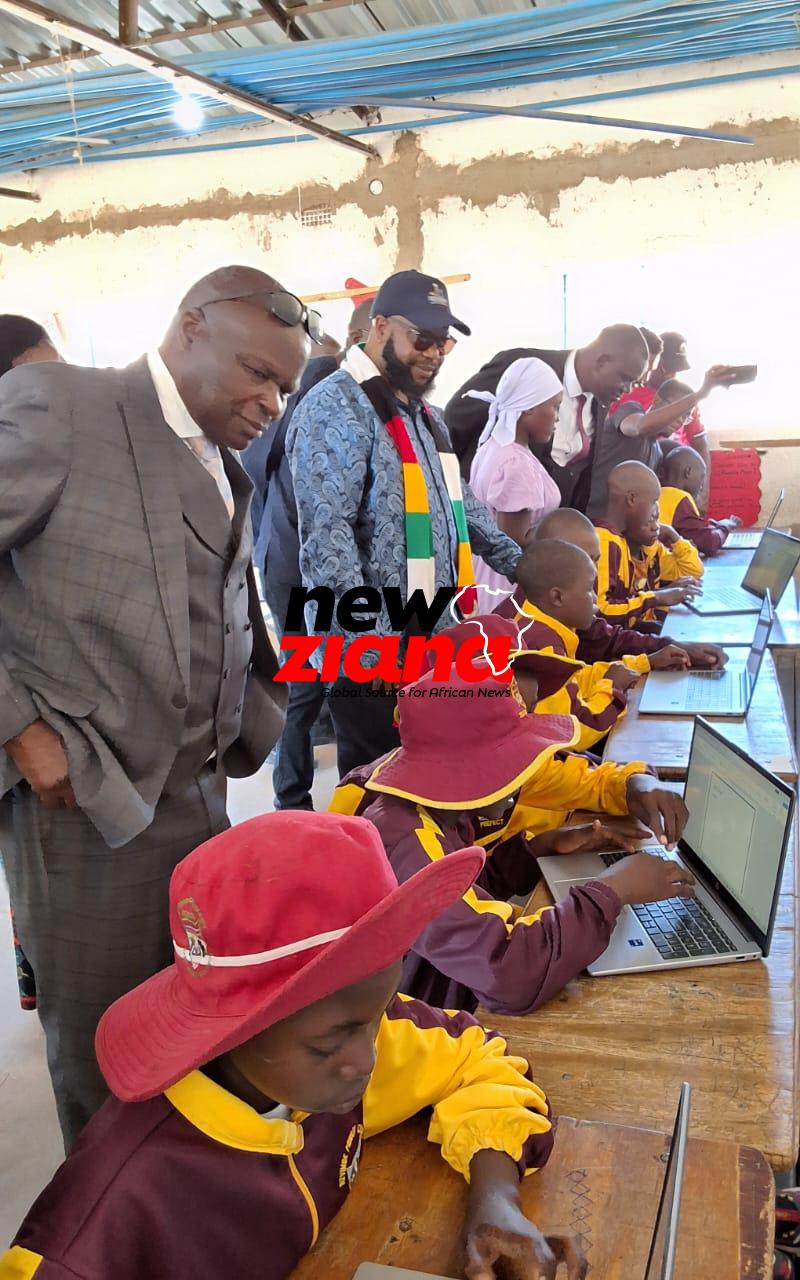
Children who once crowded around shop windows to watch television may soon enjoy the same privilege from the comfort of their own homes. Learners will be able to study at night under proper lighting, while teachers stationed in the area can now enjoy improved living conditions.
Speaking during the commissioning ceremony, the Minister of Energy and Power Development, July Moyo, described the project as part of Government’s wider efforts to ensure inclusive development through rural electrification.
“We got a mandate from President Emmerson Mnangagwa that by the end of this year, all rural clinics should be electrified such that no babies are born in darkness or with the aid of candles,” said Moyo.
He said lessons learnt during the COVID-19 pandemic exposed the deep inequalities between electrified and non-electrified schools, particularly when rural learners failed to access online lessons due to lack of power.
“This occasion marks a significant milestone in our journey towards sustainable energy access and inclusive development for all rural communities in Zimbabwe,” he said.
“Today we celebrate not just the installation of solar panels and infrastructure development, but the empowerment of rural communities who over the years have been forced to live under unbearable conditions due to the absence of modern energy services.”
The Government is also pushing ahead with the Presidential Household Solar System programme aimed at electrifying 1.2 million households nationwide by 2030.
REA acting chief executive officer, Felisters Makumbinde, said the Nzvimbe project involved the construction of more than 11 kilometres of network lines to connect schools, health institutions, businesses and households.
The project, she said, commenced in October 2024 and was completed in December 2025 at a cost of more than ZiG11.7 million.
Makumbinde revealed that in Makoni District alone, REA has electrified 120 primary schools over the years, with only 35 remaining outstanding. Fifty-two secondary schools and 34 rural health centres have also been electrified.
Beyond schools and clinics, electricity is also reshaping rural economies. At Nzvimbe Business Centre, shop owners and entrepreneurs are already beginning to reap the benefits.
Local businesswoman Martha Machingura said access to electricity has significantly improved trading conditions.
“We did not expect to have electricity at this place, but we are now selling fresh products and cold drinks, boosting our business in the process,” she said.
For tailor and entrepreneur Davius Mushavi, electricity has turned hard manual labour into a more productive enterprise.
He has since acquired an electric sewing machine, enabling him to produce school uniforms, church regalia and other garments more efficiently.
“I will soon employ one or two people to assist me in my business and help Government realize Vision 2030 through job creation,” he said.
At Nzvimbe Secondary School, headmaster Peter Seremwe believes electricity will help improve teacher retention and academic performance.
Teachers can now use electrical appliances such as refrigerators and televisions, making rural postings more attractive.
Students, meanwhile, will have more time to study after sunset, potentially improving pass rates.
Across Manicaland Province, REA says it has accelerated rural electrification projects through grid extensions, solar mini-grids, institutional solar systems and biogas digesters. Nationally, hundreds of institutions have already been energised through both grid and off- grid solutions.
Under REA’s public institutions programme, schools, clinics, Government offices and irrigation schemes receive electricity connections free of charge, as the country moves towards a target of universal rural electrification by 2030. For communities like Nzvimbe, electricity is no longer a distant dream.
As night falls over the once-dark rural settlement, glowing lights now illuminate homes, businesses and classrooms — a visible sign that development is finally reaching communities long left behind.