


By Ishmael Tagurenyika
At 1 a.m., 76-year-old Vaidah Tinga Murahwa was praying inside her Greencroft home when she heard metal being forced apart outside.
Moments later, unknown attackers were trying to break through her burglar bars.
The intruders failed to gain entry. But they did not leave. Instead, Murahwa said, they allegedly set her house on fire.
“It was around 1 a.m. when I was praying, and I heard something breaking my burglar bars,” she recalled.
“These people failed to break in because my house had strong security measures.
“After failing to break through my house, the robbers decided to burn my house. I lost everything. I am now a beggar. I do not know how I am going to rebuild my house.”
For Murahwa, the attack destroyed a lifetime of possessions.
For Harare residents, it has become part of a wider pattern.
Official statistics suggest robbery is declining in Zimbabwe. Yet a data analysis of crime reports, police operations, court outcomes and security advisories reveals a troubling reality: violent robbery is becoming increasingly concentrated in the country’s capital.
And one finding stands out above all others.
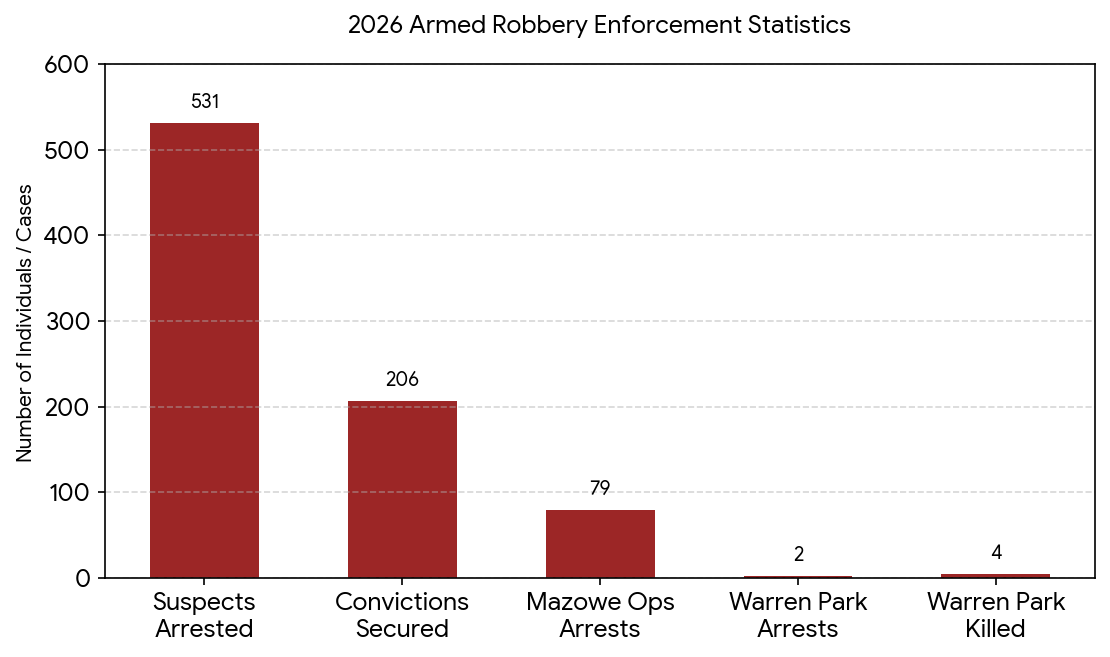
Despite hundreds of arrests linked to armed robberies, fewer than four in every 10 suspects arrested have been successfully convicted.
The figures raise questions about whether law-enforcement efforts are keeping pace with increasingly organised criminal activity.
National decline hides Harare’s growing burden
According to the Zimbabwe National Statistics Agency (ZIMSTAT) Fourth Quarter Crime Statistics Report for 2025, Zimbabwe recorded 2,640 robbery cases during the final quarter of the year, down from 2,884 cases recorded during the same period in 2024.
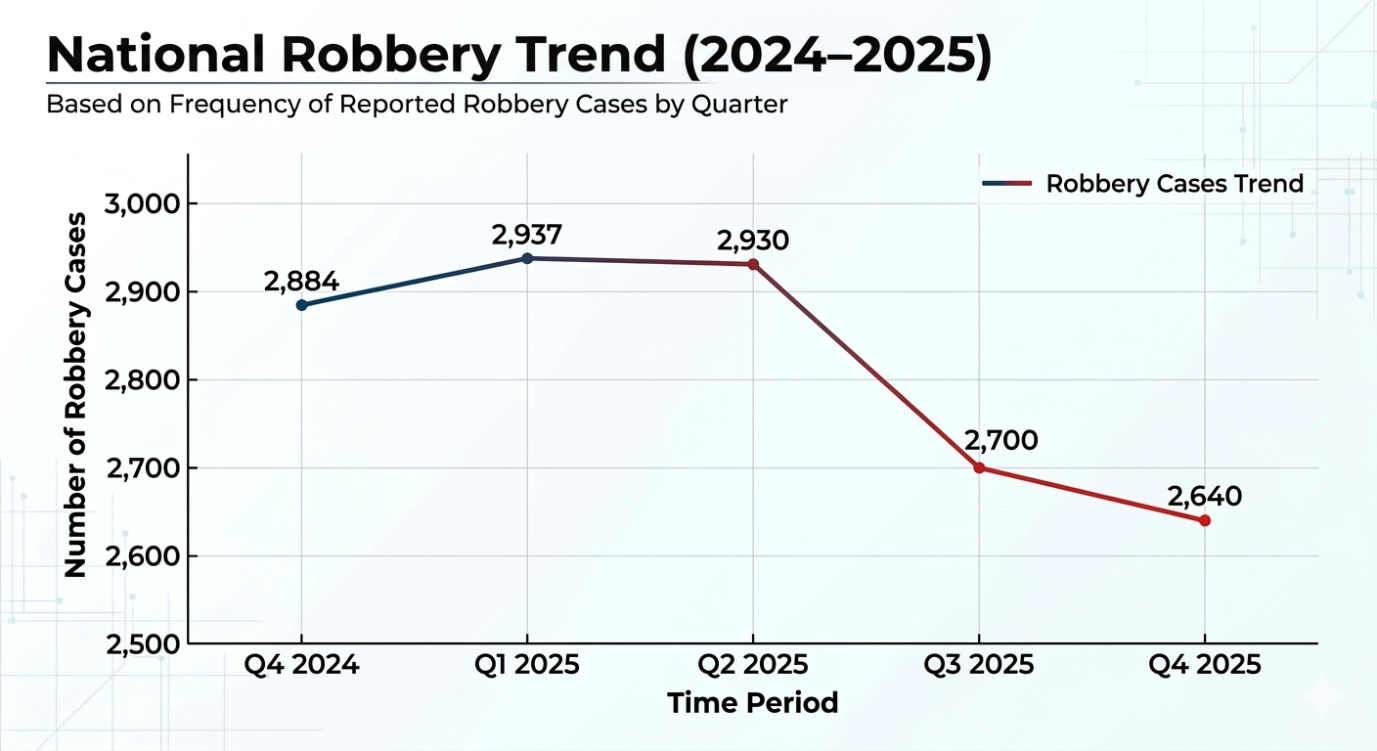
Source: ZIMSTAT 2025 Robbery Statistics Report
On paper, the trend suggests improvement.
But a closer examination of the data tells a different story.
Harare alone recorded 725 robbery cases during the quarter, accounting for nearly 27 percent of all robberies reported nationally.
The capital also recorded the country’s highest overall crime rate at 6,195.3 crimes per 100,000 people, more than double the national average of 2,812.7.
The concentration of robberies in Harare means that while the national picture appears stable, residents in the capital are experiencing a very different reality.
According to police reports and court records reviewed for this data investigation, there were a US$500,000 cash robbery in Harare’s central business district, a Mandara home invasion in which robbers stole US$17,000 and a vehicle, attacks on churches in Westgate, and raids targeting schools, money-transfer agencies and businesses.
Reports compiled from police statements, court records, media reports and private security advisories reveal a recurring pattern: criminals are increasingly targeting locations believed to hold large amounts of cash.
Harare records the highest number of robbery cases nationally
Provincial crime statistics place Harare well ahead of every other province for robbery offences.
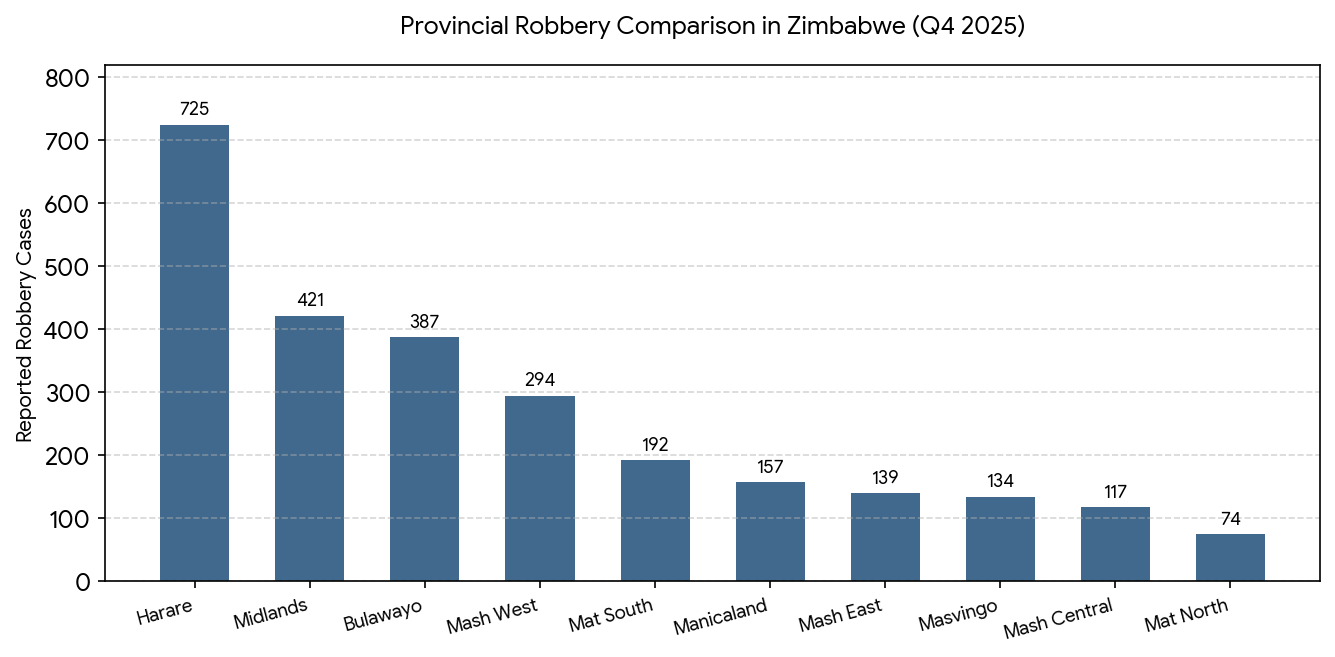
Source: ZIMSTAT Provincial Crime Statistics show Harare as the most affected province.
With 725 cases recorded in the fourth quarter of 2025, Harare almost doubled the 421 cases recorded in Midlands Province, the province with the second-highest number of robberies.
The figures correspond with a growing stream of robbery reports emerging from suburbs across the capital.
Recent incidents have affected Mabelreign, Marlborough, Westgate, Warren Park, Glen Norah, Mabvuku, Mandara and surrounding areas.
Data reviewed for this investigation indicates that robberies are no longer dominated by opportunistic street theft.
Instead, criminals are increasingly targeting homes, churches, schools, fuel stations, money-transfer agencies, construction sites and motorists carrying cash.
Police reports reviewed for this investigation show repeated attacks involving multiple suspects, firearms, getaway vehicles, and coordinated targeting of cash-handling institutions patterns that security experts say are consistent with organised criminal groups.
Security analyst John Mhlanga said the nature of robbery has evolved.
“We are increasingly seeing intelligence-driven attacks rather than random acts of theft,” Mhlanga said.
“Criminals are selecting targets, monitoring movements and focusing on places where they believe large amounts of cash are available.”
The investigation’s most alarming finding
While the arrests and convictions were recorded during the same police reporting period, authorities did not specify whether all convictions related directly to the suspects arrested during those operations
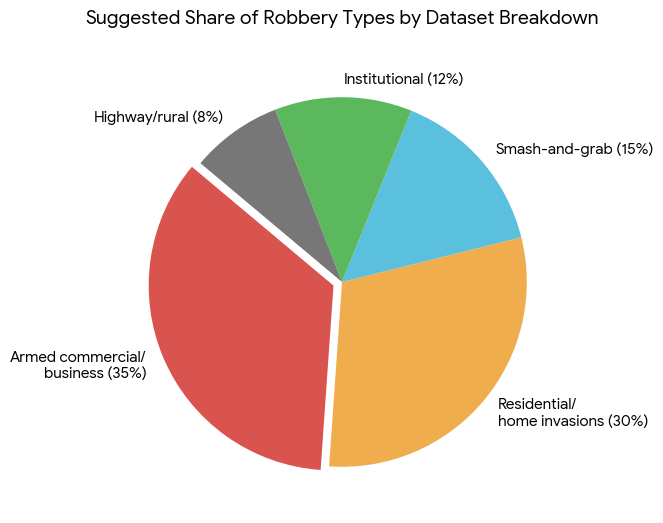
The robbery pattern suggests organised gangs are increasingly shifting from opportunistic street theft toward targeted armed raids on cash-handling businesses, residential suburbs and institutions with weaker security systems.
The figures indicate that fewer than 39 per cent of arrested suspects were successfully convicted.
In practical terms, for every 10 suspects arrested, fewer than four were convicted.
The gap raises concerns about prosecution capacity, evidence gathering and the ability of the criminal justice system to permanently remove repeat offenders from communities.
Legal practitioner Admire Rubiya said arrests alone do not guarantee public safety.
“An arrest is only the beginning of the justice process,” Rubiya said.
“What ultimately matters is whether investigations produce sufficient evidence to secure convictions. If cases collapse before conviction, communities may continue seeing the same offenders returning to the streets.”
Security experts say low conviction rates can undermine public confidence, particularly when high-profile robbery incidents continue despite repeated police operations.
The conviction gap emerged repeatedly throughout the data reviewed for this investigation and remains one of the clearest indicators of the challenges facing law-enforcement agencies.
Police fight back
Police spokesperson Commissioner Paul Nyathi said authorities had intensified operations against armed robbery syndicates.
“We have engaged intelligence units and CID crack teams to deal decisively with violent criminal syndicates operating in Harare,” Nyathi said in police updates.
Recent operations have resulted in firearm recoveries, arrests and the disruption of suspected robbery networks.
Authorities say crackdowns conducted in Harare, Mazowe, Bulawayo and Kwekwe have produced significant results.
Yet the conviction figures suggest enforcement alone may not be enough.
The challenge facing authorities is no longer simply making arrests.
It is ensuring successful prosecutions while simultaneously addressing the conditions that allow robbery networks to flourish.
Following the money
A review of robbery incidents reported between late 2025 and mid-2026 reveals a common thread.
Cash.
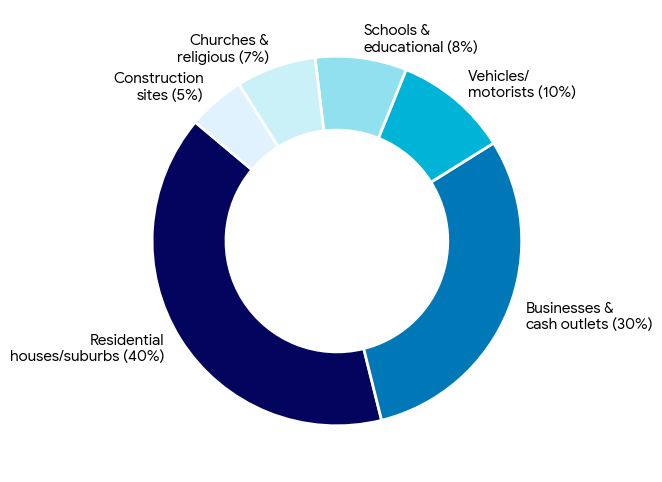
The majority of high-value robberies reviewed involved targets handling large volumes of cash, reflecting the risks associated with Zimbabwe’s cash-dependent informal economy.
Money-transfer agencies, churches collecting offerings, businesses handling daily takings, schools collecting fees and homeowners perceived to keep cash on premises have increasingly become targets.
Zimbabwe’s continued reliance on cash transactions has created opportunities for criminals seeking high-value targets.
Security advisories issued by private security companies have repeatedly warned businesses and institutions against predictable cash-handling routines.
Several incidents reviewed during this investigation involved attackers who appeared to possess prior knowledge of their targets.
In one case, robbers targeted a Mukuru money-transfer outlet in Mabelreign.
In another, churches in Westgate were attacked.
The pattern suggests criminals are increasingly identifying vulnerable locations where cash can be obtained quickly before police arrive.
Mapping Harare’s robbery hotspots
The robbery wave is not evenly distributed across the city.
Police operations, community meetings, councillor reports and security briefings consistently identify western suburbs as some of the most affected areas.
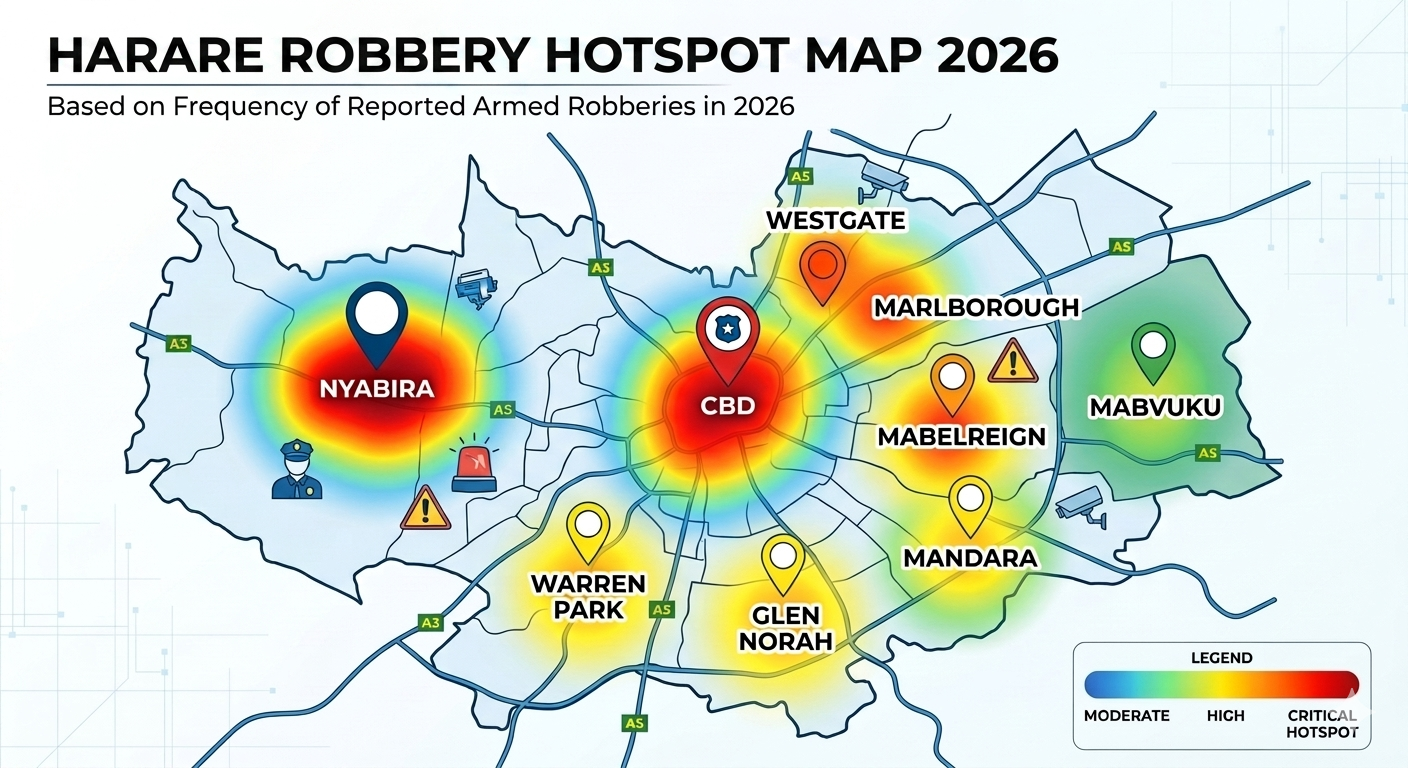
Based on the frequency of reported armed robberies in 2026
Westgate, Marlborough, Mabelreign, Warren Park and Nyabira repeatedly appear in police reports and community security discussions.
Recent police operations demonstrate the intensity of the problem.
In March and April 2026, four suspected armed robbers were shot dead during a gun battle with detectives in Warren Park while two others were arrested.
Investigators linked the suspects to a series of commercial robberies.
Yet other suspects remain at large.
Two individuals captured on CCTV during a robbery in Westgate had not been arrested at the time of reporting.
The persistence of such cases has raised questions about surveillance systems, investigative capacity and the ability of authorities to prevent repeat attacks.
A city going dark
As investigators reviewed robbery reports from across Harare, one factor appeared repeatedly.
Darkness.
Residents, councillors and security experts consistently identified poor street lighting as a major security concern.
In suburb after suburb, robbery incidents were linked to poorly lit roads, malfunctioning streetlights and deteriorating infrastructure.
Harare West Ward 16 Councillor Denford Ngadziore said residents had repeatedly raised concerns about inadequate security infrastructure.
He called for improved street lighting, stronger municipal security systems and the installation of automated boom gates in vulnerable neighbourhoods.
Ward 41 Councillor Kudzai Kadzombe said residents in Marlborough and Mabelreign were living in fear after a series of violent robberies.
“Council intervention is urgently needed,” Kadzombe said.
She identified poor street lighting as one of the major concerns repeatedly raised by residents.
Harare West legislator Joana Mamombe said theft and vandalism of public infrastructure had worsened the problem.
“Street lights have been stolen,” she said during a community security meeting.
“They also removed the solar lights.”
Residents argue that the issue extends beyond criminal activity.
Despite repeated complaints and community meetings, many affected areas remain poorly illuminated at night.
Security experts say such conditions create ideal operating environments for robbers.
Accountability questions emerge
The findings place increasing pressure on public institutions responsible for urban infrastructure and public safety.
A City of Harare engineering official acknowledged that vandalism, infrastructure theft and budget constraints had affected street-light maintenance programmes in several suburbs.
The official said repairs were ongoing but admitted that resource limitations remained a challenge.
A ZESA representative also pointed to persistent theft of cables, transformers and other infrastructure as factors affecting public lighting systems.
However, residents interviewed for this investigation questioned why known robbery hotspots continued experiencing prolonged infrastructure failures despite repeated reports.
Security economist Enoch Dhlamini said criminals often conduct surveillance before launching attacks.
“There is something called hardening of targets,” Dhlamini said.
“Electric fences, surveillance cameras, durawalls and physical guards are all measures designed to make attacks more difficult.
“When criminals identify areas that are poorly protected, those places become attractive targets.”
The result is a growing divide between communities that can afford private security and those that cannot.
Residents increasingly rely on private security
Across Harare, residents say daily routines are changing. Businesses close earlier. Families avoid travelling at night.
Neighbourhood WhatsApp groups have become informal emergency warning systems.
Private security companies now play a larger role in crime prevention than ever before.
Security advisories warning residents about suspicious vehicles, criminal tactics and robbery trends are now commonplace.
For wealthier suburbs, electric fences, alarm systems, armed response services and neighbourhood patrols have become standard security measures.
Lower-income communities often have fewer options.
Chrispen Murima, a Harare resident, believes criminals exploit weaknesses within informal markets.
“A poorly regulated informal sector allows stolen equipment and gadgets to be sold easily in places like Siyaso and Mbare,” he said.
Another resident, Kudakwashe Makaya, said limited police patrols have left some communities feeling exposed.
“Criminals are taking advantage of limited police patrols in residential areas,” he said.
The city behind the statistics
The numbers tell one story.
The people living behind those numbers tell another.
For residents in Harare’s robbery hotspots, the issue is no longer an abstract crime statistic.
It is a daily reality shaping how they travel, work, worship and sleep.
Official figures may show robbery declining nationally.
Yet the evidence reviewed for this investigation points to a growing concentration of violent crime in Zimbabwe’s largest city.
The data shows robberies clustering in Harare.
The incidents show increasingly targeted attacks.
The conviction figures expose weaknesses beyond policing alone.
And the recurring complaints about darkness, failing infrastructure and limited surveillance reveal a city struggling to keep pace with evolving criminal threats.
As night falls across parts of western Harare, gates are locked earlier, alarms are activated and neighbourhood WhatsApp groups begin exchanging warnings.
For many residents, the question is no longer whether robberies are occurring elsewhere.
It is whether the next attack will happen on their street.
And while national statistics suggest robbery is falling, the reality unfolding in Harare’s suburbs tells a far more unsettling story.