
By Johnson Siamachira
Harare, (New Ziana) — Tawanda Bukuta remembers when his family’s land offered little more than a place to plant maize, and wait for the rain.
The 41-year-old smallholder farmer in Ward 12 in Mutasa district, in Manicaland Province, chose a different path when he acquired land of his own.
“I am the eldest of my father’s children,” Bukuta says. “When I was old enough to get my own land, I decided that I wouldn’t take a piece of my father’s arable farmland, but I would instead grow my maize crop on degraded, uncultivated land.”
The decision took him onto ground that other farmers had largely abandoned. Today, the land supports maize, peach trees and indigenous woodland. His nursery supplies fruit seedlings to farmers beyond his village.
Bukuta’s experience shows how some Zimbabwean farmers are restoring degraded land, and improving their livelihoods at the same time. Their work also reflects the difficulty of bringing damaged landscapes back into production in a country facing deforestation, soil erosion and increasingly unreliable rainfall.
The Forestry Commission estimates that Zimbabwe lost about 262,349 hectares of forest annually between 1992 and 2017. Agriculture, firewood collection, settlement expansion, mining, overgrazing and wildfires have contributed to the loss.
The Southern Alliance for Indigenous Resources (SAFIRE), a Zimbabwean conservation organisation, has worked with communities on agro-forestry, natural regeneration and sustainable land management.
From degraded land to productive fields
Bukuta had been working on his own, but began working with SAFIRE in 2023, when the organisation introduced farmers in Mutasa to agro-\forestry. The approach combines trees and crops while using practices such as planting pits and soil bungs to reduce runoff and erosion.
At first, some villagers questioned his decision to invest labour in land that had produced little.
Bukuta: “I was convinced that these lands, properly restored, could be more productive than existing farmland. And I proved it.”
He has restored about two hectares of degraded land on his family property and helped mobilise other farmers to undertake similar work. SAFIRE says land restoration in his community now covers about 200 hectares.
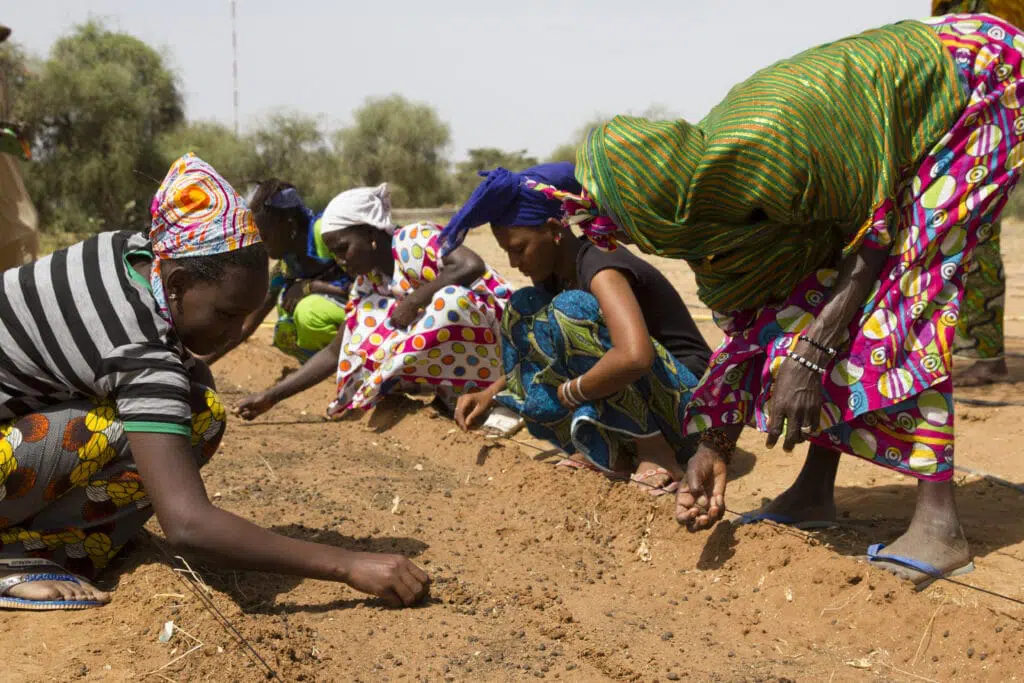
Before the rains, Bukuta prepares his land, digs planting pits and adds compost. He then plants crops and trees, allowing the soil to retain more moisture and recover its fertility.
The approach requires careful management. Trees and crops can share a farming system, but farmers must consider competition for water, nutrients and sunlight.
With SAFIRE training and technical assistance, Bukuta also established a nursery producing peach seedlings.
A nursery changes the household economy
The nursery and fruit orchards have become important parts of Bukuta’s farming enterprise.
He grows peach seedlings alongside indigenous trees, including acacia, muwonde and mukute. SAFIRE says he manages a diversified agro-forestry system covering about two hectares, with approximately 600 mature peach trees.
The nursery supplies farmers and markets in Makoni district, Beatrice, Murehwa and Nyanga. A peach seedling sells for about US$2, according to project information.
Before joining the restoration programme, Bukuta depended mainly on rain-fed maize and occasional casual labour. He says those activities brought in less than US$100 a month.
His nursery and other enterprises now generate more income, although earnings vary with the farming season and demand for seedlings. SAFIRE reports that his income can reach about US$1 500 per month.
“Lasting conservation is achieved when local people are empowered to restore, manage and sustainably benefit from their natural resources,” says SAFIRE director Estella Toperesu.
“By introducing the forestry restoration project, we’re empowering the community to take control of their livelihoods, their environment, food security and create new income-generating opportunities.”
The additional income has helped Bukuta pay for his children’s education and household needs.
“One of my children is in Form Six at a local school,” he says.
Through the forest restoration project, Bukuta and his fellow smallholder farmers received training in business skills such as budgeting and recordkeeping.
“This new knowledge to look at agro-forestry as a family business, and the training in budgeting, marketing and good agricultural practices have transformed my farming enterprise,” he explains.
“We did not treat agro-forestry as a family business before, and as a result, we could not make any profits from the practice,” Bukuta said, adding: “I can now buy sugar, cooking oil, soap, and flour — developments I never dreamt of. I’ve even built a modest new home for my family.”
He has since invested in five apiaries and is exploring fish farming to spread the risks associated with drought and fluctuating agricultural markets.
Restoration becomes a community effort
Bukuta’s results have encouraged neighbouring farmers to experiment with similar methods.
Francis Madzara, a farmer in the area, says previously barren ground has become pasture and cultivated land.
“In the past, we couldn’t grow anything here,” Madzara says. “Then we saw that when he practiced agro-forestry, he had good maize yields. So we began to do it, too.”
Bukuta helped form the Bonda Fruit Tree Orchards and Nursery Group, which brings together 60 farmers. The group manages peach trees and supplies seedlings to farmers in several districts.
SAFIRE’s Mutasa forest restoration project works with communities in Wards 5, 11, 12 and 19. Project information says the initiative has planted more than 567,000 trees, produced over 300,000 seedlings through community-managed nurseries and restored degraded forestry land through assisted natural regeneration.
The organisation says its wider programmes have reached more than 33,000 households over the past decade, planted more than 500,000 trees and restored 50,000 hectares of degraded land.
Such figures do not, however, show how many planted trees survive or how long restored land remains productive. SAFIRE’s activities include fire management, community resource-management committees and monitoring of tree survival.
The cost of bringing land back
Water remains Bukuta’s biggest concern.
“No water, no life,” he says.
Drought, frost and grazing animals can kill young trees before they establish roots. SAFIRE project reports also identify water shortages, transport delays and climate conditions as factors that reduce tree survival.
Farmers must protect seedlings from livestock, maintain soil structures and replace trees that die. Fencing and community agreements can help, but both require time and money.
Bukuta spends up to US$180 a year on trees and labour for restoration activities on his land, according to SAFIRE. He also gives seedlings and advice to neighbours.
His experience shows that restoration is not a single planting season. It requires continued work, investment and protection of the land.
A national challenge
Zimbabwe has committed to restoring two million hectares of degraded forest landscapes by 2030 under the African Forest Landscape Restoration Initiative and the Bonn Challenge.
In September 2026, the country also launched a Farmer Managed Natural Regeneration scale-up framework aimed at restoring one million hectares and supporting 250,000 farming households by 2033.
The approach focuses on protecting and managing naturally regenerating trees and shrubs rather than relying solely on planting new trees.
These commitments place local experiences such as Bukuta’s within a wider effort to repair damaged landscapes. They also raise questions about how governments and organisations will measure tree survival, maintain restoration sites and ensure that benefits reach farmers with little land or capital.
Back in Mutasa, Bukuta continues to work with the soil he once regarded as unproductive.
“Before, I felt helpless and resigned to the challenges of rural poverty,” he says. “Now, I have a sense of control over my family’s future.”
He is willing to share what he has learnt.
“I’ll teach anyone who wants to know how to restore degraded land,” he says. “With the results I have achieved here, there is no land that I cannot recover.”
-New Ziana