By Mvelo Mthiyane Zondo
GWANDA — The Parliamentary Portfolio Committee on Primary and Secondary Education, in collaboration with the Thematic Committee on Gender, conducted a field operation and fact-finding mission at Senondo and Collen Bawn primary schools to assess the national School Feeding Programme and the provision of sanitary wear for girls.
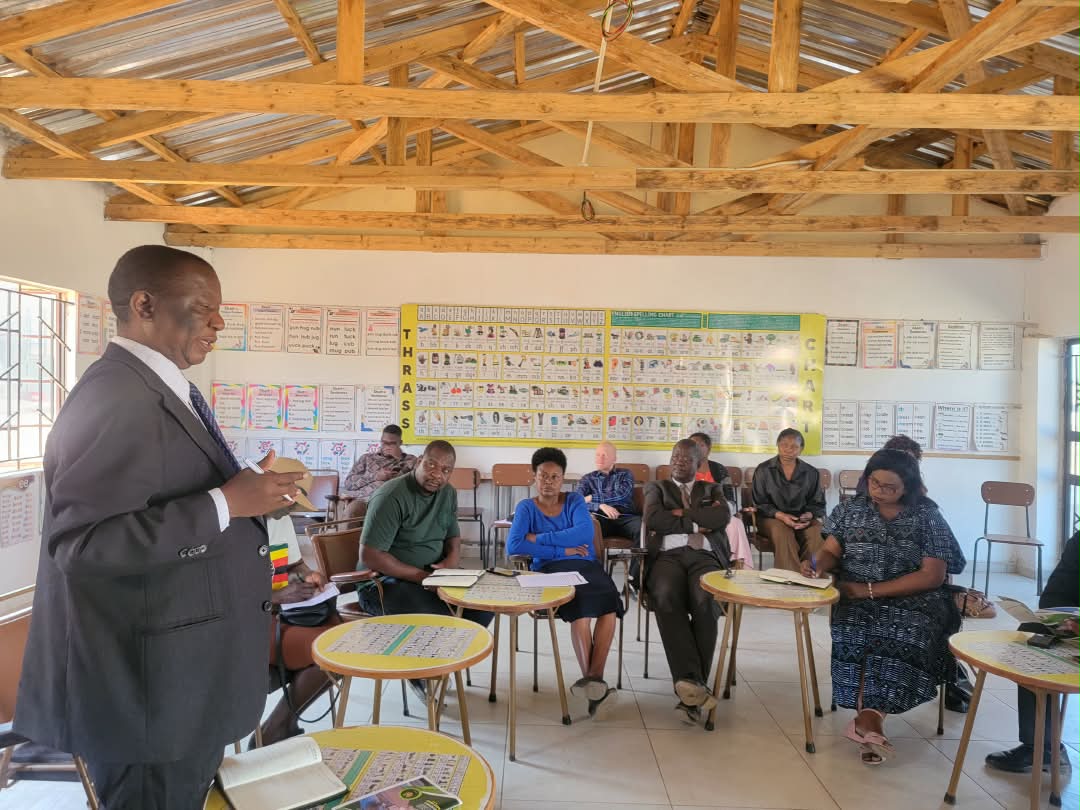
Acting committee chairperson Tanatsiwa Mukomberi expressed satisfaction with Senondo’s operations and outlined the objectives of the mission before the meeting and tour of projects.
“We are not on a witch-hunt but on a fact-finding mission regarding the school feeding programme and sanitary wear provision for the girl child.
Our main objective is to assess the operational impact, which is why we are here to physically inspect how the School Feeding and Sanitary Wear Provision Programmes are implemented on the ground,” said Mukomberi.
Before giving the floor to Gwanda District Schools Inspector Sydney Sibanda and Senondo school headmaster Vusumusi Tshili, Mukomberi emphasized their focus on how schools employ self-sustaining initiatives, such as nutrition gardens and poultry projects, to enhance dietary variety and supplement government provisions.
“Our mission is also guided by section 75 of the constitution, which mandates the government to ensure every child has the right to access state-funded education. The school feeding programme is directly linked to attendance and performance. In assessing pass rates, we find some schools with zero percent and others with 100 percent,” said Mukomberi.
There needs to be coordination between the availability of school feeding and the pass rate, attention, and attendance of learners. In some cases, pass rates sharply increased after the introduction of the school feeding programme, while the opposite occurred where feeding stopped—pass rates, attendance, and learner attention all dropped.
In his report, District Schools Inspector Sibanda said Senondo Primary is a role model that exemplifies the mission’s objectives.
“School feeding began in 2014, when the government supplied grain as a staple, and schools, through their development committees, sourced relish. In 2017, the government stopped supplying grain, so schools turned to home-grown solutions, with partners and farmers stepping in to ensure learners continued to receive a hot meal every day,” said Sibanda.
Regarding sanitary wear, he said the programme targeted girls in Grades 5, 6, and 7, who received reusable sanitary pads from the government.
“The sanitary wear programme targeted older primary school girls, while all girl learners at secondary level benefited. For boarding schools, the focus was mainly on underprivileged and day scholars who were financially disadvantaged,” he said.
He added that UNICEF also complemented government efforts by providing US$600 to selected schools, which was used to purchase utensils such as large pots, plates, and spoons.
The school head, a man of few words, told the committee that he had little to say but much to show. The committee then moved to the school’s income-generating projects.
“We have several income-generating projects that make up our school business unit. As a result, our school feeding programme operates daily, ensuring our learners receive a hot meal. To sustain this, we run a 2,000 broiler project supported by a fish pond with a capacity for 4,000 fish, 73 pigs, 48 rabbits, 40 road runners, and a horticultural garden,” said Tshili.
After touring the projects—from the tuckshop to the garden and fowl runs—the committee expressed satisfaction and applauded the school head for transforming the school into a business unit.
This development has resulted in fee stability for the past three years. Senondo’s school fees have remained at US$55 since 2023, and there is a strong possibility they may decrease further if the projects continue to succeed.
“We are impressed by both the oral and physical evidence. All school heads should come here for an exchange visit to learn and observe. What we witnessed will greatly enrich our report on school feeding, as we saw more than we expected. Special thanks go to the parents and School Development Committee. The school and its learners are exemplary,” said Mukomberi.
In a light moment, Mukomberi joked with the SDC chair and the DSI to guard their headmaster, as he could be transferred to improve other schools or moved to Harare.
Past and ongoing committee findings have highlighted structural challenges, including cases where schools receive staple ingredients like mealie-meal but lack the finances or resources to provide necessary relish, vegetables, or access to clean water.