By Johnson Siamachira
BINGA, Zimbabwe, March 23, 2026 (New Ziana) — Binga rural communities in Matabeleland North Province in north-western Zimbabwe, long plagued by food insecurity and poverty, are slowly turning away from wildlife poaching. They are achieving this through breeding improved, bigger goats and diversifying their incomes, which is in turn benefiting wildlife conservation and enhancing community development in this vast biodiversity-rich district. Here, in the heart of Zimbabwe’sKavango-Zambezi Transfrontier Conservation Area (KAZA), a new breed of hope is emerging—stronger goats, stronger communities, and a stronger commitment to conservation.
As Zimbabwe races against time to meet its goal of placing 30 per cent of its land under conservation by 2030, the Sustainable Wildlife Management (SWM) Programme is reshaping rural livelihoods.
Most parts of Binga District fall within the Zimbabwean agro-ecological classification of natural region five, meaning the land is unsuitable for crops and suited mainly to extensive grazing and game ranching.
Binga is the third poorest district in Matabeleland North Province. With poverty rates exceeding 88 per cent, improved livestock production programmes are not just desirable—they’re essential.
The SWM Programme is promoting good natural resources utilisation, including wildlife, as an economic and sustainable land-use option. The initiative operates on the basic philosophy of empowering local communities to better manage and benefit from wildlife and other natural resources.
For decades, Binga’s communities have lived alongside elephants, lions, and hyenas—not always peacefully. Wildlife trampled crops and devoured livestock. “In 2019, I lost my entire two-hectare traditional grains crop to marauding elephants in addition to losing five cows to lions,’’ says Mpendula Mwiinde from Chidyo 1 Village.
But now, thanks to the SWM Programme, which is funded by the European Union and implemented by a partnership consortium which includes the Food and Agriculture Organization (FAO) of the United Nations, the French Agricultural Research Centre for International Development (CIRAD), the Center for International Forestry Research and World Agroforestry (CIFOR-ICRAF) and the Wildlife Conservation Society (WCS). Communities are benefitting from co-existing with wildlife through schemes such as the improved goat farming project.
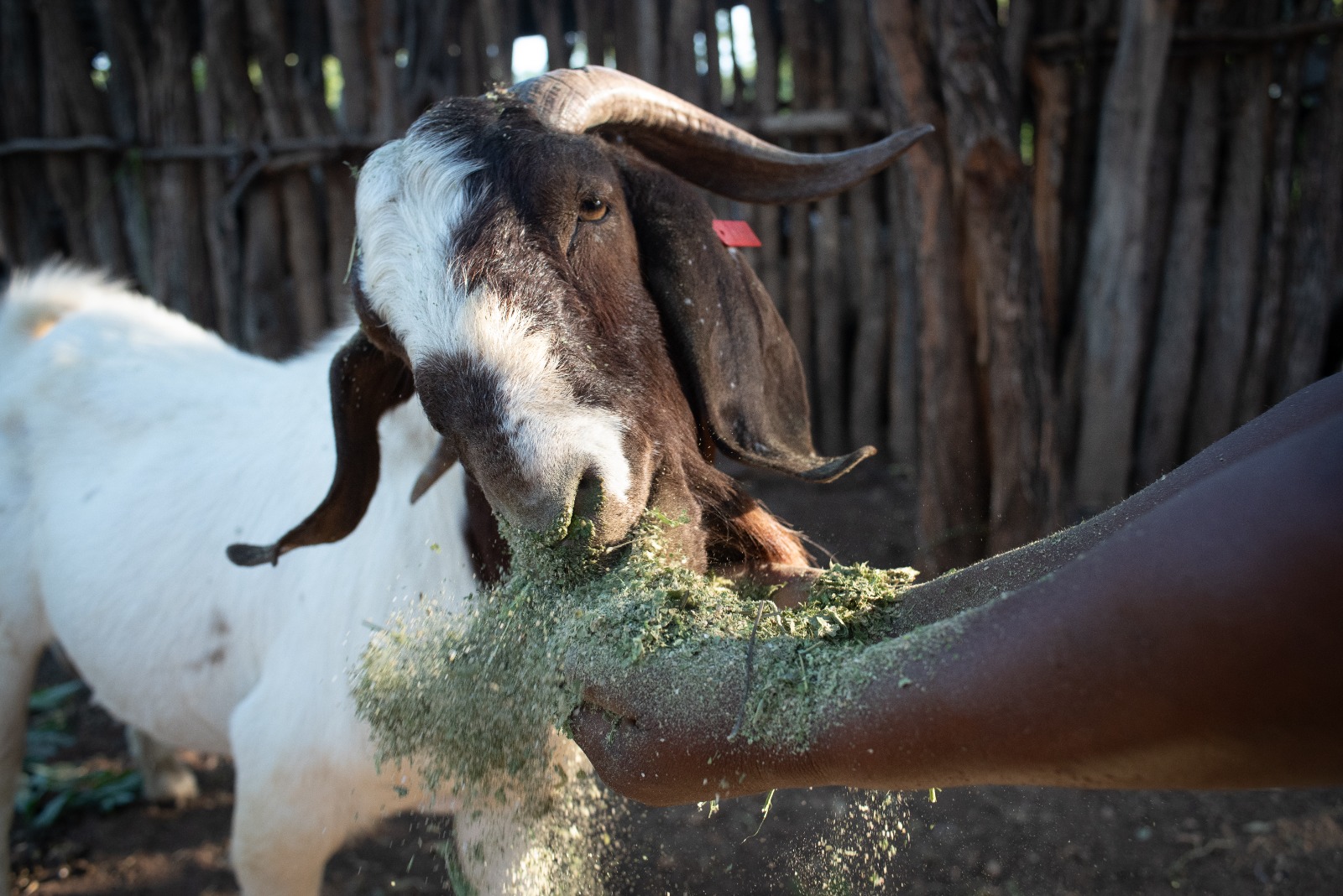
To generate new income sources for the farming families without depleting wildlife, the programme helped the community establish the Mucheni Community Conservancy and to acquire Boer and Kalahari goat bucks — very robust and high-yielding breeds. The Kalahari bucks (adult males) weigh between 85-105 kg while the does (breeding female goats) weigh 60-80 kg. The Boer bucks weigh 95-120 kg while the does weigh 70-90 kg. These figures are based on management in communal or semi-extensive agricultural systems.
“I am looking forward to earning more money from my goats,” Mwiinde says, adding that her native goats usually sell for up to US$20 each depending on their size. Marketed offspring (12–18 months) have a live weight of 35–60 kg under communal systems, while well-managed offspring (18–24 months) reach 60–80 kg and exceptional stud animals may exceed 100 kg at maturity.
For a typical Mucheni Community Conservancy household with 10 breeding maiden-does, the income difference is substantial. Indigenous goats produce about 10–12 kids per year, sell at roughly US$25 each, and yield about US$250 annually. Crossbreds produce 15–20 kids per year, sell at about US$50 each, generating approximately US$750, tripling household incomes, according to the Mucheni Community Conservancy livestock sales reports.
Based on goat sales conducted in Bulawayo in 2025, the income gain on the improved breeds was two or three times that of local breeds. These gains are strengthening household incomes, asset accumulation, and resilience among participating communities.
The goat breeding initiative in Binga has already benefited over 3,800 households. The bucks have sired over 1,500 kids. Farmers are also reporting higher survival rates and faster growth.
The bucks are shared by communities on a rotational custodial basis where a lead farmer hosts the buck for some time for servicing his or her female goats and those for neighbours’ and then passes the buck to another lead farmer who does the same. Farmers receive the bucks free of charge and the monthly cost for keeping each animal is about US$10 for feed and medicine.
The Mucheni Community Conservancycovers three chiefdoms—Sinampande, Sinakoma, and Sinansengwe across three wards. Here, villagers have organised themselves into governance structures, trained 18 natural resource monitors, who conduct anti-poaching patrols. The SWM Programme has also introduced mobile bomas to deter predators and reduce retaliatory killings. The bomas are used on a rotational basis in the villages and serve to both protect livestock and improve soil fertility where they will be set up.
“We have seen a 10-fold reduction in snares and poaching incidents,” said Mathias Mugande, a resource monitor in Ward 5. “People now see wildlife as a shared resource, not a threat.”
“These goats are not just animals,” said Alexander Mudenda, a farmer and former poacher from Mucheni Village. “They are our insurance against hunger. I slaughter some of them for sale and to feed my family. I have stopped hunting down plains game like antelopes and impalas for meat and for sale,” says Mudenda.
Even better, Mudenda is no longer losing livestock to predators. “In 2019, I lost 29 goats and three cows to lions and hyenas. However, after erecting a brown mat screen around my livestock pen, I’m no longer experiencing these challenges. We use this method to protect our livestock since by concealing them, predators such as lions cannot attack them as they cannot see the livestock.’’
A local Binga veterinary extension supervisor, Taurai Gonye speaks highly about the improved goat breeding initiative: “In the past, the communities had poor quality goat breeds with low growth rates. With the Boer and Kalahari breeds from other areas, the local people are pleased that after cross breeding they have attained an improved livestock quality,’’ adding: ‘’These goats grow faster and give birth to multiple offspring at once.’’
Another smallholder farmer, Levia Mugande, from Chivwetu Village, says: “Goats are gold to us. Mucheni is more than a conservancy — it’s our home, our heritage and our shared responsibility for a sustainable future,”
The communities are moving away from wildlife corridors and there is a decline in cases of farmers being arrested for poaching.
Mthokozisi Dlodlo, SWM Programme`s Acting Site coordinator in Zimbabwe, says the shift is grounded in community ownership and empowerment. “We’re not just giving goats—we’re giving people the tools to manage their land, protect their wildlife, and build a future.”
The initiative has had its fair share of challenges. For example, drought and limited access to markets, still threaten sustainability. Only a few bucks survived the initial introduction, revealing a need for better veterinary support and climate adaptation strategies.
“The return on investment in conservation takes time,” said Dlodlo. “But with community leadership and sustained support, it’s a future worth investing in.”
As Zimbabwe looks to scale this model across the other 64 districts, the Mucheni story stands as a living example—proof that with the right support, conservation can be a catalyst for both biodiversity and human dignity.
Smallholder farmer Shupa Muchimba summed it up: “This land is ours. If we don’t protect it, who will?”