TRADITIONAL leaders in the Gutsa area of Domboshava led villagers during a
non-stop two-day kukumbira mvura/mukwerera/mutoro/nhuruka/ (rain
imploring/petition ceremony).
The atmosphere was a reconnection with the spriritual as everyone walked
barefoot, clad in their classic African or traditional attire.
The rain imploring/petitioning ceremony was magical with a star-studded line-
up in action, backed up with dancing at the incredible traditional event.
What made it the more remarkable was the youthful champions of the event.
In historical times, whenever indications pointed to uncertainty regarding when
the rains would be due or when there were no signs of impending rains in the
skies, the elders led by a svikiro, called for mukwerera/mutoro/nhuruka.
But two weeks ago, it was not the elders, who decided on the ceremony. It was
a group of traditional practitioners in their late/early forties, who led this return
to Indigenous African Knowledge at Gutsa Village in the scenic Domboshava
area, north-east of the capital, Harare.
The participants had their own champions in the likes of Eunice Kapandura,
Sekuru Humba, Sekuru Mutimbanepasi, Ambuya Muchadura, Ambuya
MaSithole, Ambuya Gamuchirai Muvhimi, Chihera Chido Musasiwa and
Othneil Mangoma.
Soon after arrivals for the two-day event and refreshments, there was
nhangaruvanze to the accompaniment of music and dance by an mbira group.
This was followed by kugashira vaeni/vaenzi nekuzivana, led by Chief Murape
and Village Head Gutsa. This introductory process was followed by a
discussion on the history of rain imploring/petitioning, commonly incorrectly
referred to as “rain making” and the different customs of the ethnic groups
represented, the values and systems that preserve water and the responsibilities
of each traditional leader.
Children from the neighbourhood gave a special highlight performance. After
presentation of children’s dances, there followed a nature walk, firstly to allow
the participants to familiarise themselves with site and its surroundings, but also
acting as if to inform the ancestral guardians of the arrival of the participants
and their intentions.
After the evening’s repast, matters went a gear up as the proceedings moved
into the pungwe phase of music, dancing and singing, imploring the heavens to
open up. This lasted into early Sunday morning.
The mukwerera/nhuruka is a common practice of asking for the rains among the
Shona-speaking peoples of Southern Africa. It is usually conducted between
July and October of each year.
In historical times, such a ceremony was conducted under a
muhacha/muchakata/muchechete/mukamba tree, where traditional brew is
offered to the ancestors.
The theatre of the process would move to a venue, away from the
muhacha/muchakata to a village setting dominated by dancing to the sound of
drums being played and people feasting.
In the majority of the cases, the skies would open up in answer to the rain
petitioning.
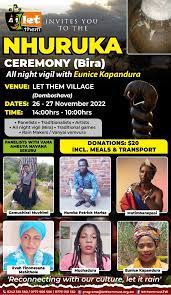
Dubbed Nhuruka National Festival 2022, The Domboshava event was an
awakening, self-discovery and learning curve for more than 200 participants,
who turned up for the event.
Festival director, Chido Musasiwa, in selecting Domboshava, provided a setting
that mirrored historical sites of the rain imploring ceremonies such as the
famous Njelele in Matobo or Halisupi/Musendami in Gwanda as groups of
spirit mediums, traditional healers, artists and culture enthusiasts found
themselves against a backdrop of vast granite outcrops.
The traditional parts of the event were led by Eunice Kapandura, who set the
stage for a sombre, calm and collected spiritual note that had slow evoking
songs without musical instruments.
Globally known for her healing smile, coupled with consistency in spiritual
consultations and distinctive teachings on healing and rainmaking, her presence
was a force to reckon.
As if in response, the rains came for a good hour after she and her team had
performed rituals under the muhacha tree.
In her usual pursuit of amplifying the voices of traditional people she led a
panel of healers that included Sandra Maburuse (Mbuya Muchadura), Patrick
Marisa (Sekuru Humba), Evah Tinonesana (Mbuya MaSithole), and Gamuchirai
Chirisa (Mbuya Vanjapa).
These healers had amazing stories of their individual journeys in relation with
water conservation, environment upgrading for sacred purposes as well as rain
petitioning traditions.
This was followed by wide spiritual consultations and music being played
throughout the two days.