
By Thabisani Dube
HARARE — The absence of clear ethical guidelines in palliative care often leaves patients, families, and healthcare professionals to face complex and emotional decisions regarding treatment options, sharing diagnoses, and planning end-of-life care.
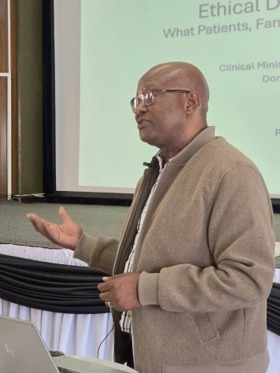
Palliative care physician Dr. Dickson Chifamba of Island Hospice and Healthcare highlighted this challenge during the ongoing Safeguarding and Media Workshop in Harare. The workshop, held under the theme “Creating Safe Communities: Safeguarding and Digital Responsibility,” brings together professionals dedicated to fostering safer, more compassionate environments.
Dr Chifamba noted that ethical dilemmas frequently arise when the wishes and values of patients, families, and healthcare providers do not align, underscoring the need for open communication and mutual understanding.
The workshop, which started on Aug. 19 and ends on Aug. 30, brings together religious sisters from different congregations working in areas such as nursing, education, orphanages, and old-age homes, among others.
Dr Chifamba said Zimbabwe does not have formal guidelines to help healthcare workers navigate some of the ethical challenges arising in palliative and end-of-life care.
“When you look at the Zimbabwean context, we don’t have guidelines regarding how ethical it is,” Dr Chifamba said.
He said one of the major dilemmas involved truth-telling about a patient’s diagnosis and prognosis, particularly in cases of cancer and other life-threatening illnesses.
Dr Chifamba said some families asked healthcare workers not to disclose a diagnosis to a patient, believing that the information could cause distress.
However, he said patients themselves often wanted to know the truth about their condition.
He cited a survey conducted in Ghana in which 96 percent of patients said they wanted to be told whether they had cancer and whether the disease was treatable.
Dr Chifamba said this could create tension between patient autonomy and family authority, particularly in African communities where culture, religion, and family preferences can influence medical decisions.
He also highlighted dilemmas surrounding aggressive treatment for patients with advanced illnesses, including decisions about whether to continue intensive care and ventilation when treatment may no longer provide meaningful benefit.
Dr Chifamba said healthcare professionals may find it difficult to withhold or withdraw treatment because of their professional duty to save lives.
He said family members may also experience moral distress when forced to choose between continuing aggressive treatment and accepting the natural progression of an illness.
Another challenge, he said, involves misconceptions surrounding opioids such as morphine, which are commonly used to manage severe pain.
Dr Chifamba said some families fear that morphine could hasten death or is only appropriate for patients who are dying, resulting in some patients not receiving adequate pain relief.
He said ethical decision-making should take into account principles such as patient autonomy, beneficence, non-maleficence, and justice, while also considering family circumstances, culture, religion, and available resources.
Dr Chifamba urged families and healthcare professionals to begin conversations about patients’ wishes and end-of-life preferences early, before an illness progresses to a stage where patients can no longer make decisions for themselves.
He said South Africa has developed guidelines addressing some ethical challenges in healthcare, which could provide lessons for Zimbabwe.
The workshop is equipping the participating sisters with knowledge of safeguarding, digital responsibility, caregiving, palliative care, dementia, and ethical decision-making as they work with communities in different settings.