
Opening statistics
In Zimbabwe, gender-based violence is not just gender-based violence remains a persistent social and public health challenge it is something the country keeps measuring, and the data keeps confirming. The United Nations defines gender-based violence as any act that causes physical, sexual or psychological harm, including threats, coercion, and arbitrary deprivation of liberty. In Zimbabwe, women from different backgrounds report that harm is persistent, woven into the realities of relationships and community life.
Recent Zimbabwe Demographic and Health Survey findings show that 27% of women have experienced physical violence since the age of 15, while 13% report physical violence within the past 18 months.
Those figures matter because they place violence in two time frames at once: a lifetime reality and an ongoing one. It is not only what happened before; there is evidence of what continues now.
Trends over time
The survey results suggest that society has not decisively shifted away from violence. Women’s reports of physical violence since age 15 have fluctuated, but they have not fallen away. In 2005-06, 36% of women aged 15–49 reported ever experiencing physical violence; the figure was 30% in 2010–11; 35% in 2015; and 27% in 2023–24. The movement across years can be read as improvement for some groups and periods, but the broader picture is more troubling: violence remains common enough to keep returning in new survey cycles.
Age and provincial patterns
Age patterns further underline how GBV can become concentrated around particular life stages. Among women, reported physical violence since age 15 drops to 15% for those aged 15–19, then rises sharply to a peak of 34% among women aged 25–29, before decreasing among women aged 30 and older. In practical terms, the data suggests that risk is shaped by life circumstances such as relationship dynamics, financial dependence, and negotiation of power within households rather than being evenly spread across society.
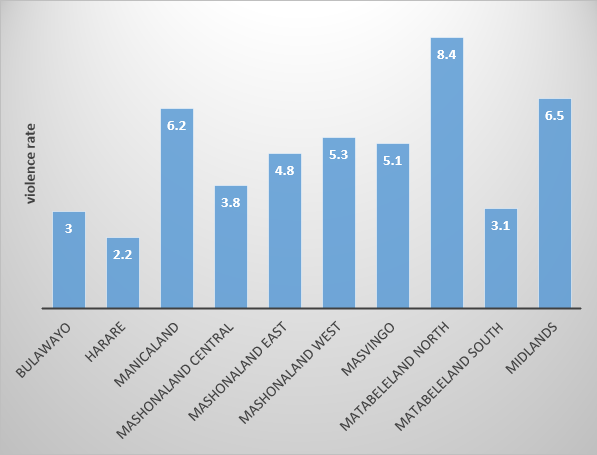
Location adds another factor. Physical violence since age 15 varies by province, reaching 38% in Matabeleland North, while predominantly urban provinces such as Harare and Bulawayo report lower prevalence. For residents in Harare, the temptation might be to treat the highest numbers as someone else’s problem, but the pattern points to the way local contexts economic conditions, norms, access to support systems, and reporting practices can shape violence and how it is measured.
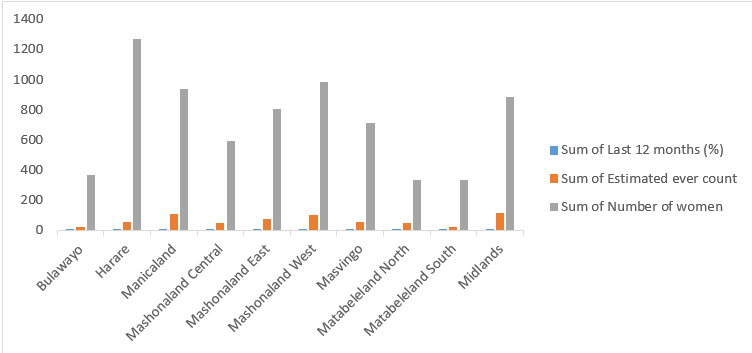
The data also shows that violence frequently occurs within intimate relationships and households. It frequently occurs within intimate relationships and reflects power dynamics within households.
In 2023–24, 3% of women reported committing physical violence against a husband or intimate partner, up from 2% in both 2010 – 11 and 2015. Even more telling is that the proportion of women who have ever committed physical violence against a husband or partner has stayed at 4% since 2010 –11, implying that certain social scripts around violence endure even as specific recent figures change.
Survivor
For nearly twenty years, Pamhidzai Mashongwe,* 44, of Gokwe lived with her husband in what was once a shared home with a man who once stood in front of a classroom shaping young minds. Today, she shares only bruises, silence, and a terrifying thought: that death might be kinder than staying.
Her husband was a respected primary school teacher until his health failed. Then came retirement. Then came the shouting. Then came the fists.
“Now, there is no peace in my home,” says Mashongwe, her voice trembling from a corner of Gokwe where help rarely arrives. “He curses me. He beats me. He says I am embarrassing him. But he is the one who is sick inside he never wanted to stop working. Now he thinks I am the cause of all his trouble.”
Her experience reflects challenges faced by many women across the country. For her, the national figures are not abstract. She has no money to see a counsellor or return to her relatives. She cannot sleep. She has stopped dreaming.
And recently, she started thinking about killing herself just to stop the next beating. She says the abuse has severely affected her mental wellbeing and left her feeling trapped.
“Going to the courts or the police feels like a dream,” she says.
Expert analysis
Across Zimbabwe, the data tells the same painful story. Violence has not fallen dramatically in nearly two decades. It has simply moved through different ages, provinces, and relationships proving that old beliefs, gender stereotypes, and weak accountability are still alive.
Award-winning gender journalist Lazarus Sauti echoes this view: “The country has strong laws to promote gender equality. Nevertheless, putting these laws into practice still faces major challenges.”
Gender activist Daphne Jena, who works with a local women’s rights organisation, argues that laws alone do not remove inequality.
“Many women in Zimbabwe already know from daily life that old beliefs, gender stereotypes, political tension, discrimination, weak protection, and poor accountability still make many women vulnerable especially those who face more than one kind of disadvantage at the same time.
Existing legal framework
Zimbabwe has positioned gender-based violence as a matter of rights, not just policy. Domestically, the Domestic Violence Act (2007) was designed to prevent and mitigate household violence, while online GBV is addressed through the Cyber and Data Protection Act (Chapter 12:07). The National Gender Policy (2023–2030) frames GBV as a major obstacle to women’s participation in political, economic and social life. Internationally, Zimbabwe has pledged to instruments like CEDAW and the Maputo Protocol.
Why implementation gaps remain
Despite these commitments, experts say implementation gaps continue to limit the effectiveness of legal and policy frameworks. For Mashongwe, the ‘challenges’ of implementation have a name: poverty, isolation, and a failing mind. Across the country, weak protection and poor accountability mean that even strong laws fail to reach the women who need them most.
Conclusion
So the question hanging over Gokwe and every province from Harare to Bulawayo is no longer whether Zimbabwe knows how to stop gender-based violence. Activists argue that stronger implementation and accountability are now required to do more than just measure it. Zimbabwe’s challenge, captured in these statistics, is not simply to respond after violence occurs.
The data story is that violence persists across age groups, provinces, and relationship contexts an indication that the country is still confronting the everyday structures that allow gender-based violence to survive.
*not her real name