By Zachary Gava
Harare, (New Ziana) – Hhigher and tertiary education graduates in Zimbabwe should transition from being job seekers to innovators and entrepreneurs capable of driving the industrialization agenda, a senior government official has said.
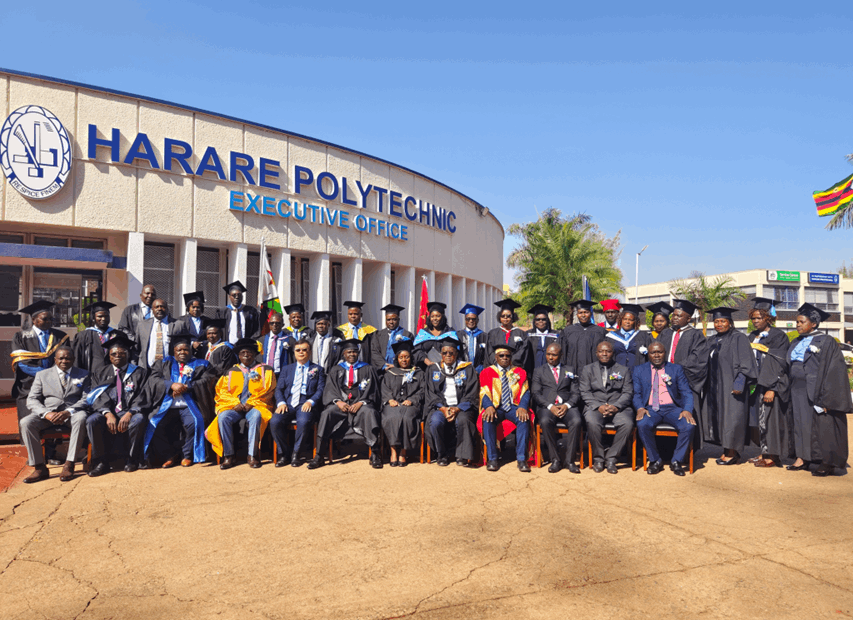
Deputy Minister of Higher and Tertiary Education, Innovation, Science and Technology Development Simelisizwe Sibanda said this at the 46th Harare Polytechnic graduation ceremony on Friday, where 4 788 students graduated’
Sibanda said the institution was playing a pivotal role in producing the skilled human capital required to transform Zimbabwe into an upper-middle-income economy under the vision to become an upper middle income society by 2030 (Vision 2030).
He said the graduation theme, “From Learners to Innovators: Powering National Industrialisation through Technopreneurship,” reflected Government expectations that graduates should become creators of technology and industry leaders rather than merely consumers of innovation.
“This theme embodies the Government’s expectation that our graduates will not merely consume technology but generate it; not leave workshops as job seekers, but emerge as technopreneurs prepared to drive Zimbabwe’s industrialization agenda. Harare Polytechnic has thus positioned itself as a vital engine of national productivity and transformation,” he said.
Sibanda said the government has placed human capital development at the centre of national transformation, noting that the graduating class this year reflects the growing emphasis on science, technology, engineering and mathematics (STEM).
Of the 4 788 graduates, comprising 2 377 women and 2 411 men, more than 60 percent graduated in STEM disciplines, a development he attributed to deliberate Government policy aimed at building a knowledge-based and technology-driven economy.
Sibanda applauded the Harare Polytechnic for aligning its programs with the National Development Strategy 2 (NDS2), particularly through outreach initiatives promoting rural industrialization in Murombedzi and Muzarabani.
He described the institution’s classroom construction project in Murombedzi, Mashonaland West province, as a practical demonstration of skills transfer that leaves a lasting legacy in rural communities.
“Harare Polytechnic has embraced this call through Integrated Skills Extension and Outreach Programs currently under implementation in Murombedzi and Muzarabani. We applaud the institution for adopting Murombedzi as a rural industrialisation hub,” he said.
Sibanda also highlighted the institution’s growing contribution to innovation, citing the production of electric vehicle golf carts through reverse engineering and the establishment of an Automotive Centre of Excellence in partnership with industry players including Autoworld, Isuzu, CFAO and ZIMOCO.
He said the government would support the retooling of automotive, mechanical, electrical and science engineering workshops to sustain these industrialization initiatives.
“This is technopreneurship in action: turning knowledge into infrastructure, and infrastructure into opportunity for national development,” he said.
Sibanda commended the polytechnic for embracing artificial intelligence in teaching and learning in line with the Ministry’s Innovation and Education Agenda 2026, saying the adoption of AI and expanded digital infrastructure positioned Zimbabwe’s technical education system to compete in the Fourth Industrial Revolution.
He noted that the institution had reduced student admission processing time by 40 percent through a digital enrolment management system while expanding campus Wi-Fi coverage from 40 percent to 80 percent.
“This forward-looking adoption of digital infrastructure ensures our commitment to equip graduates with skills for the Fourth Industrial Revolution,” he explained.
Sibanda further praised the Harare Polytechnic’s growing international profile through partnerships with institutions in China, student exchange programs as well as its participation in regional education and industrial exhibitions, saying such collaborations were enhancing technology transfer and Zimbabwe’s global competitiveness.
On access to education, Sibanda reaffirmed Government commitment to ensuring no deserving student is left behind, citing scholarship programmes, the Work-for-Fees initiative and support for students living with disabilities as evidence of an inclusive higher education system.
He urged the graduates to use the knowledge and skills acquired to build industries and contribute meaningfully to national development.
New Ziana