Staff Reporter
MUTOKO – President Emmerson Mnangagwa on Thursday commissioned the Mutoko Bioeconomy Industrial Park, a landmark project expected to accelerate rural industrialisation, create employment and promote value addition in Mashonaland East Province.
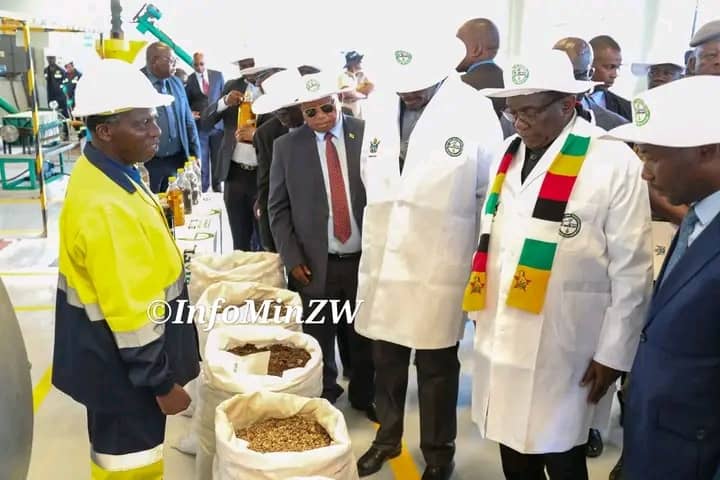
Before officially commissioning the facility, President Mnangagwa toured the industrial park, which houses a biodiesel factory, a soap manufacturing plant and a cooking oil refinery. He later unveiled a commemorative plaque marking the official opening of the state-of-the-art industrial hub.
The industrial park, developed by Finealt Engineering under the Ministry of Higher and Tertiary Education, Innovation, Science and Technology Development, is aligned with the National Development Strategy 2 (NDS2) and Vision 2030, which seek to transform Zimbabwe into an upper-middle-income economy through value addition, beneficiation and rural industrialisation.
Speaking during the commissioning ceremony, President Mnangagwa said the establishment of the industrial park demonstrated Government’s commitment to unlocking the economic potential of rural communities by processing locally available resources into finished products.
He said the initiative would stimulate local economic development, create sustainable jobs and improve livelihoods while reducing dependence on imported products.
The President urged communities to take advantage of the opportunities created by the project by increasing agricultural production, particularly sunflower farming, which will provide raw materials for the processing plants.
The Bioeconomy Industrial Park showcases how research and innovation from Zimbabwe’s universities and tertiary institutions can be translated into commercially viable industries that create wealth, strengthen food security, generate employment and drive inclusive economic growth.
The facility also focuses on value addition and beneficiation of locally available biological resources, reducing reliance on imports, strengthening domestic manufacturing and improving Zimbabwe’s competitiveness in regional and international markets.
Permanent Secretary in the Ministry of Higher and Tertiary Education, Innovation, Science and Technology Development, Professor Fanuel Tagwira said the project was a practical demonstration of Heritage-Based Education 5.0, which promotes innovation, industrialisation and the utilisation of local resources.
He said about 20 000 households in Mashonaland East are expected to be contracted to grow sunflower, creating a reliable supply chain for the industrial park while boosting household incomes.
Professor Tagwira added that the facility would generate employment opportunities in processing, manufacturing and related value chains, contributing to inclusive rural development.
The Mutoko Bioeconomy Industrial Park is expected to become a model for similar projects across the country as Government intensifies efforts to establish industries closer to raw material sources and promote community-based industrialisation.