

Sharon Chikowore
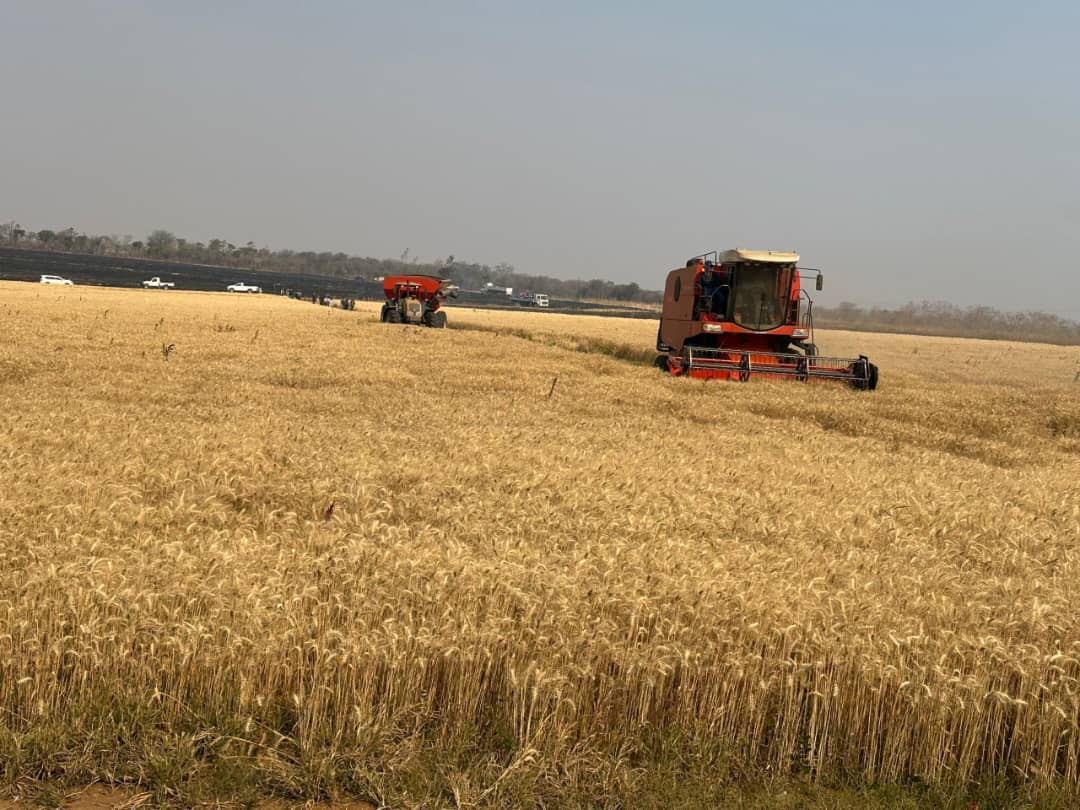
WHEAT harvesting has gathered momentum across the country, with the Government deploying all 293 available combine harvesters to wheat-growing areas as the crop reaches physiological maturity.
Agriculture Permanent Secretary Professor Obert Jiri said the country had officially entered the wheat harvesting season following the completion of irrigation activities and control measures against Quelea birds.
“Wheat harvesting here has just started in earnest. We are now officially in the wheat harvesting season,” Prof Jiri said.
He said most of the crop was now drying rapidly and harvesting was expected to intensify over the next three to four weeks as temperatures rise.
“Most of the wheat is now at the physiological maturity stage and drying out. So we expect that the farmers that haven’t started, we will see this escalate in the next three to four weeks as the temperatures soar,” he said.
Prof Jiri said the government had organised the available combine harvesters into wheat clusters to ensure that machinery was deployed to farms according to the maturity of the crop.
“We, in the country, have 293 combine harvesters which are all active at the moment. We’ve organised these combine harvesters into our wheat clusters so we know exactly where wheat is now mature and ready for harvest,” he said.
He said the clustering system was enabling early harvesting to proceed while ensuring that machinery was available when harvesting reached its peak.
At Endbase Farm in Zvimba, Banket, farmer Mr Job Dalu said timely planting and availability of inputs had contributed to the early harvesting of his 100-hectare wheat crop.
Mr Dalu said planting started on 15 April and was completed within 10 days after all the required resources, including fertiliser and tractors, had been secured.
“Our wheat is on 100 hectares. Starting from the planting stage, we managed to plant on time. We started around mid-April, on the 15th of April, which is when we began planting our wheat,” he said.
“Within 10 days, we finished planting that wheat. Thus, all required resources, whether fertilisers or tractors, were available near the property on time.”
Dalu said 70 hectares had already been harvested, leaving 30 hectares, which he expected to complete before turning attention to maize.
“Out of the 100 hectares that we farmed, as of now, we have cleared 70. Only 30 remain. This means that by 1 October, we will already be starting to harvest the maize, with the wheat phase completely wrapped up,” he said.
He said the successful wheat harvest would contribute to increased availability of grain for the baking industry.
The K2 Marshall wheat variety seed on the visited field has produced 9.5 tonnes per hectare, giving the farmer the highest ever recorded at the farm.
The province planted 31. 197.6 hectares of wheat and expects an average yield of six tonnes per hectare.
Meanwhile, Prof Jiri urged farmers to guard against veld fires during the wheat harvesting period, warning that dry conditions could increase the risk of fires spreading to standing or harvested crops.
He urged farmers to maintain properly cleared fireguards around their fields and establish fire-fighting teams capable of responding quickly when fires break out.
“We are encouraging our farmers to have fireguards surrounding their fields that are well-cleared. We also encourage our farmers to have fire gangs, so that as soon as a fire erupts, they can attend to that fire as quickly as possible,” he said.
Prof Jiri also urged farmers not to burn wheat stover, but instead bale it and use it as livestock feed.
He said the government had introduced a statutory instrument directing farmers to treat wheat stover as stock feed, making baling and removal of the residue from fields important in reducing the risk of fires.
“Our message to our farmers is that they must bale this stover, and not burn it. Once baled, it must be taken off the field, so that incidences of fire don’t really harm the crops harvested or standing in the field,” he said.
The wheat harvest comes as the government continues to promote increased domestic production of the cereal as part of efforts to strengthen food security and ensure adequate supplies for the country’s milling and baking industries.