Antony Chawagarira
Across Zimbabwe’s judicial landscape, a quiet but unmistakable shift has been unfolding—one that is steadily reshaping the face, tone and leadership culture of the justice system. Where court leadership was once overwhelmingly male-dominated, women are now occupying some of the most influential offices in law, from prosecution and judicial administration to the upper tiers of the bench itself.
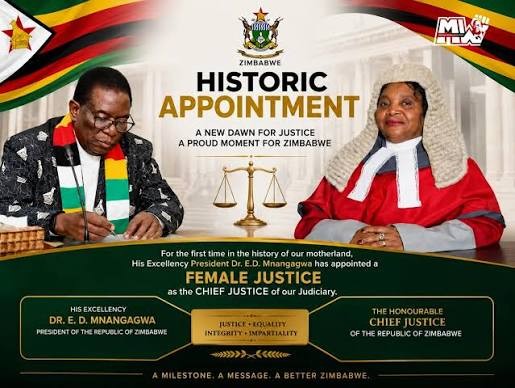
At the centre of this transformation is Chief Justice Elizabeth Gwaunza, whose elevation to the country’s highest judicial office marked a defining moment in the history of Zimbabwe’s courts. A career jurist with decades on the bench, Gwaunza’s rise from the High Court into the upper echelons of the judiciary reflects not only personal endurance but also a broader institutional shift toward gender inclusion at the very top of constitutional authority. Her presence in the Chief Justice’s office has symbolically broken a long-standing ceiling, signalling that the highest interpretive authority of Zimbabwean law is no longer exclusively male territory.
This change, however, is not isolated. It is reinforced by strong female leadership within the prosecutorial system, most notably Prosecutor-General Loice Matanda-Moyo, who leads the National Prosecuting Authority. Her role places her at the frontline of criminal justice—deciding which cases proceed to court and shaping the state’s response to corruption, violent crime and high-level economic offences. In a system where prosecutorial discretion can define the fate of major public interest cases, her position underscores the growing confidence placed in women to manage complex and politically sensitive legal processes.
Equally significant is Attorney-General Virginia Mabhiza, the Government’s chief legal adviser. Sitting at the intersection of law and policy, she is responsible for reviewing legislation, guiding Cabinet on constitutional compliance, and ensuring that state actions align with Zimbabwe’s legal framework. Her office places her at the heart of law-making itself, where legal interpretation meets political decision-making. In many ways, her role reflects how women are increasingly shaping not just how laws are applied, but how they are crafted.
Beyond the executive and prosecutorial arms of justice, the judiciary’s operational leadership has also seen meaningful change.
At the High Court level, leadership under Judge President Mary Zimba-Dube illustrates the gradual but steady normalization of women in senior judicial management roles. The Judge President’s office carries significant administrative weight—overseeing case allocation, managing judges, and ensuring the efficient functioning of one of the busiest tiers of the court system. Her presence in this role reflects a judiciary increasingly open to gender-balanced leadership in day-to-day court operations.
What makes this shift particularly notable is that it is not confined to symbolic appointments. It is structural. Women are now embedded across multiple layers of the justice system—from advisory roles in government to prosecutorial authority and judicial leadership. The combined effect is a judiciary that is not only changing in composition but also in institutional culture, with greater emphasis on accessibility, procedural discipline and responsiveness to public accountability.
At the lower court level, another important but often less visible pillar of the justice system, Chief Magistrate Munamato Mutevedzi plays a central role in shaping the day-to-day delivery of justice. As head of all magistrates’ courts across Zimbabwe, the Chief Magistrate oversees the courts where the majority of criminal and civil cases are first heard. From theft and assault cases to preliminary hearings in serious offences, magistrates’ courts form the backbone of the justice system. The Chief Magistrate ensures consistency in sentencing practices, supervises magistrates nationwide, and strengthens administrative efficiency in a court system that directly serves ordinary citizens at community level. While often operating outside the public spotlight, this role is crucial in determining how quickly and fairly justice is delivered at the grassroots.
Zimbabwe’s justice system has historically been shaped by a narrow leadership pipeline, where senior roles were drawn from a limited pool of practitioners. That pipeline is now widening. More women are entering magistracy, rising through the High Court, and taking up senior administrative and prosecutorial posts earlier in their careers than in previous decades. The result is a generational shift that is slowly but steadily altering who gets to interpret, enforce and shape the law.
Yet the transformation is still in progress rather than complete. Lower courts, particularly in rural areas, continue to reflect older gender imbalances, and the pipeline to the very top remains competitive and uneven. Still, the presence of women in the most visible and powerful legal offices signals a judiciary in transition—one where authority is increasingly shared rather than concentrated.
Taken together, these developments point to a justice system undergoing a quiet but profound redefinition. The rise of women within Zimbabwe’s judiciary is not merely a matter of representation; it is becoming a structural feature of governance itself. And as these leaders continue to shape constitutional interpretation, prosecution priorities and legal administration, their influence is likely to define the character of Zimbabwean justice for years to come.