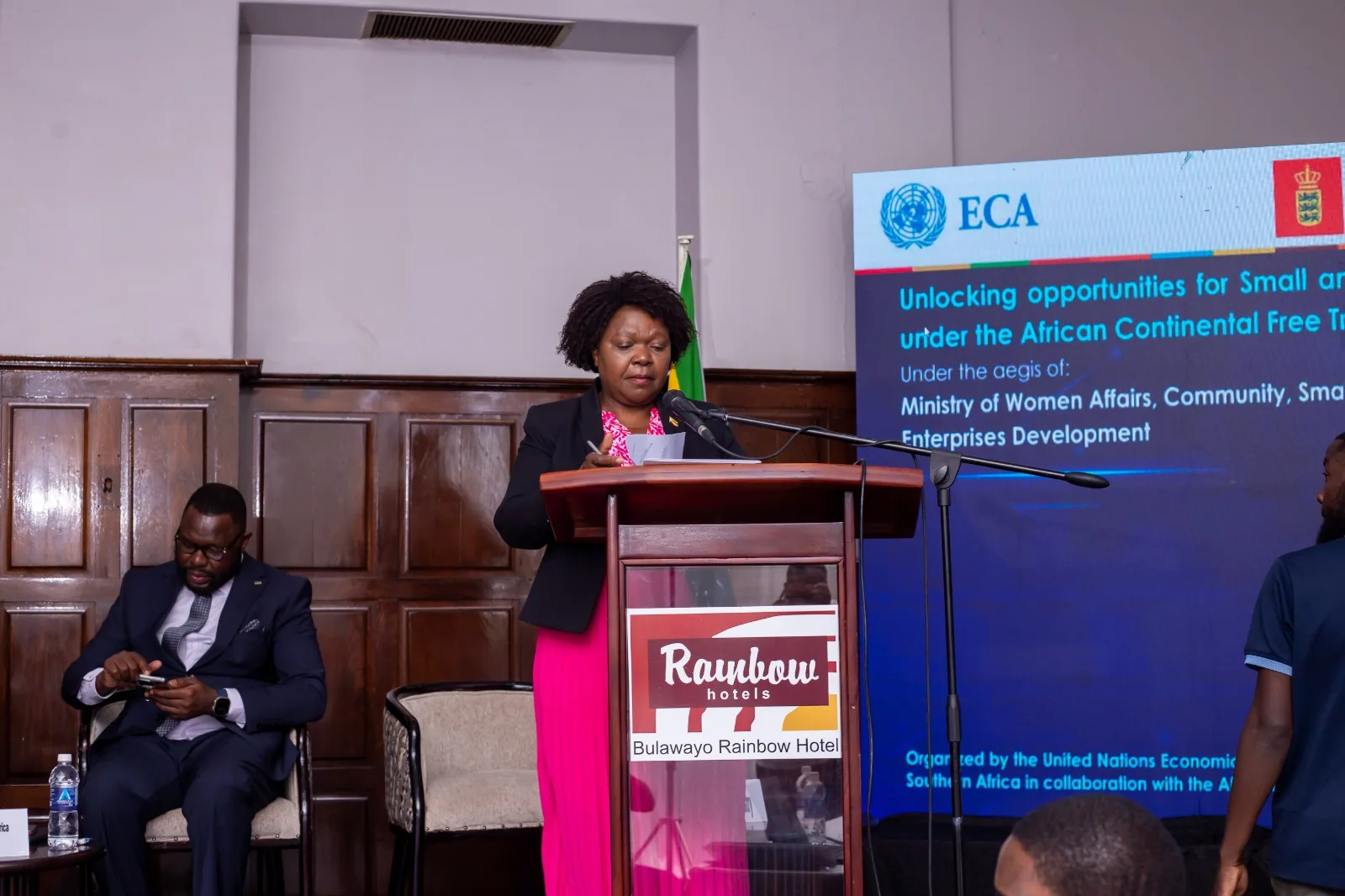
Bulawayo, (New Ziana) –The Zimbabwe government is committed to providing a supportive environment for small and medium enterprises (SMEs), ensuring they become the primary beneficiaries of the vast opportunities that the African Continental Free Trade Area (AfCFTA) presents.
Permanent secretary for the Ministry of Women Affairs, Community, Small and Medium Enterprises Development, Mavis Sibanda said this on Thursday while addressing delegates attending a two-day National Capacity Building Workshop focused on unlocking AfCFTA opportunities for local SMEs.
The workshop, supported by the Economic Commission for Africa Sub-Regional Office for Southern Africa (ECA SRO-SA) and the Government of Denmark, aims to equip entrepreneurs with the knowledge and tools to navigate the new continental trade landscape.
While acknowledging the immense potential of the AfCFTA, Sibanda said SMEs continue to face hurdles to fully participate in the agreement.
She cited critical challenges including information asymmetry, limited access to finance and investment, logistical bottlenecks, intense competition from larger African firms, and the need for greater involvement of women-led businesses.
“Given the vast opportunities before us and the challenges we must confront, Government remains firmly committed to creating an enabling environment for SMEs to thrive under the AfCFTA,” Sibanda said, outlining a multi-pronged strategy that Government is implementing to capacitate SMEs.
“Through national strategies and policies, we are strengthening value chains, facilitating access to credit, investing in infrastructure, and improving the ease of doing business so that our entrepreneurs can grow with confidence and resilience,” she said, noting that a key government priority is the full implementation of the national AfCFTA strategy.
“This includes enhancing border efficiency, simplifying and disseminating critical information to SMEs, and fostering a conducive business environment. We must also explore innovative financial instruments and forge strong public-private partnerships to expand access to capital for small businesses,” she added.
Sibanda called on Business Associations and Support Organizations to act as the crucial link between policy and practice, providing SMEs with practical guidance on product certification, quality standards, and digital marketing.
Sibanda also explained that AfCFTA is the largest free trade area in the world by number of participating countries, bringing together a single market of more than 1.3 billion people with a combined GDP exceeding US$3.4 trillion.
“For Zimbabwe, this is more than just an economic statistic, it is a gateway to new markets, enhanced competitiveness, and sustainable industrialization. For SMEs, which make up over 70 percent of enterprises, this opportunity is especially significant as it opens the door to countless possibilities,” she said.
Sibanda also said the AfCFTA agreement seeks to progressively eliminate tariffs on most goods and services, enabling SMEs to export their products to 54 African countries with greater ease and at lower cost.
“Furthermore, the agreement is designed to foster regional value chains, enabling SMEs to become vital suppliers to larger corporations across the continent. It also promises to streamline cumbersome customs procedures and harmonize standards, thereby reducing the non-tariff barriers that have historically stifled cross-border trade.
Sibanda said government continues to expose many SMEs to many regional markets including Botswana, Zambia, Malawi, Tanzania, and Lesotho among others.
“Currently, we have 50 SMEs products that are being exhibited at Japan World Expo 2025. With the advent of AfCFTA, the market has become bigger and better,” she said.
New Ziana