

By Johnson Siamachira
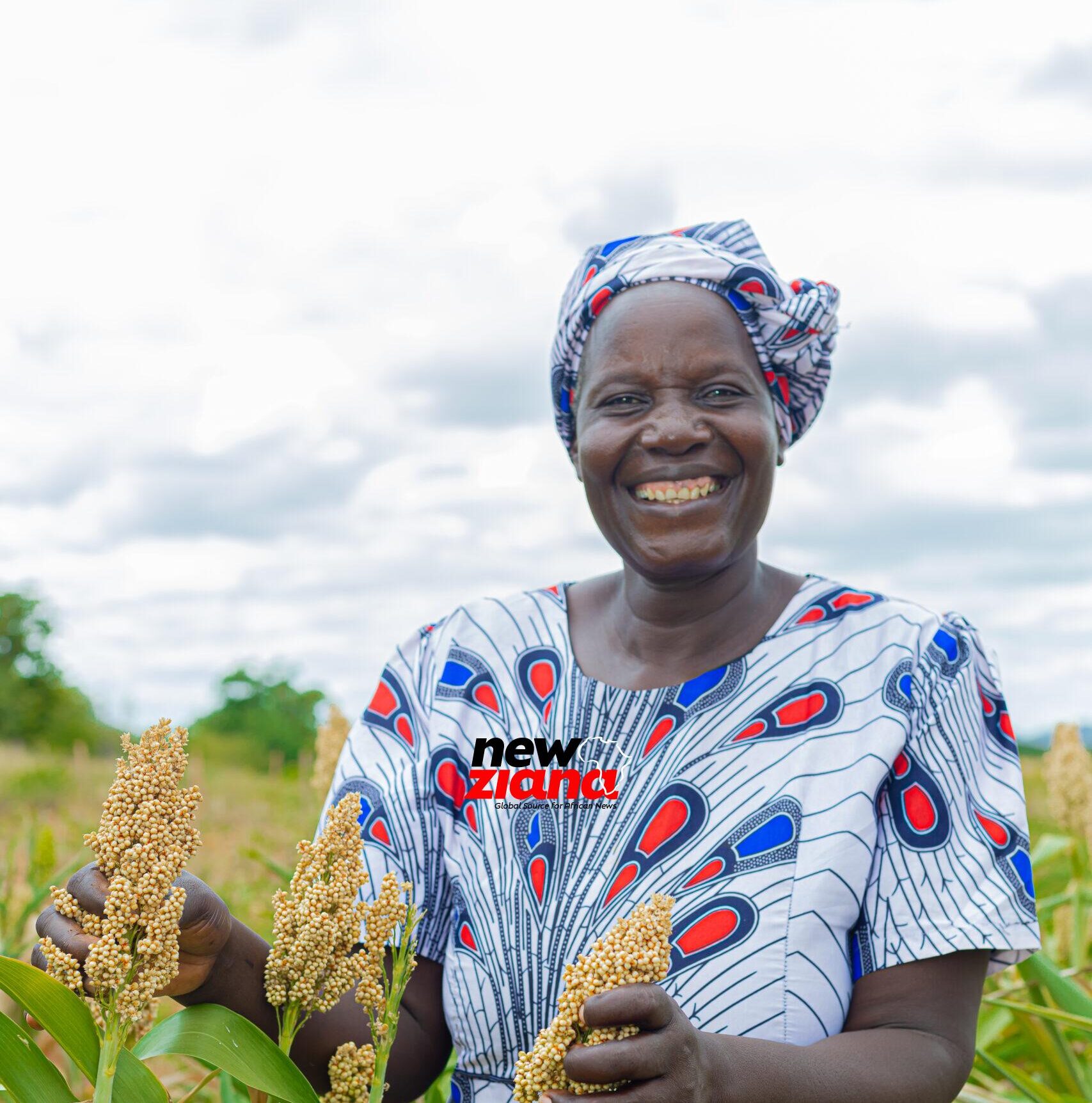
Harare, (New Ziana) –There are only two dark spots in the story of Migren Mutamba’s life. One is the devastating 2015/2016 El-Nino induced drought. The other is the passing on of her husband who was helping her with their on-farm trials focusing on traditional grains, and short season maize varieties using Conservation Agriculture.
Mutamba lives in Katakura Village in Ward 8 of Rushinga district in Mashonaland Central Province in northern Zimbabwe. For her, life on the farm was marked by tedium, drudgery, and persistent climate challenges. Today, life on this farm has shifted from daily hardship and monotony to one defined by resilience and renewed hope. Reflecting on the past: “Before, I would wake up at 4am just to scrape by on my small plot.’’
For over three decades, she relied solely on maize, Zimbabwe’s staple crop, but faced with critical yield shortfalls due to outdated practices and erratic rainfall. That reality began to change with the promotion of traditional grains and climate-smart agriculture through the R4 Rural Resilience initiative This initiative offered a lifeline to smallholder farmers like her and has sparked an agricultural transformation in Rushinga.
Zimbabwe is home to about 17 million people, with approximately 68 per cent living in rural areas. For most, agriculture is a way of life, yet farming stability is threatened by climate change and variability, from rising temperatures, diminishing rainfall, and persistent droughts. Approximately 80 per cent of rural households depend on rainfed agriculture, making them vulnerable to fluctuating weather patterns. ‘We’re no longer sure when to prepare our land or when to start planting because the rains no longer come in time and are often insufficient—it feels like we’re gambling with nature,’’ Mutamba says, highlighting the urgency of adaptive measures.
The United Nations’ 2025 reports underscore the severity of the situation. In response, Zimbabwe’s Multi-Sectoral National Food and Nutrition Strategy for 2023-2025 emphasises climate adaptation in agriculture as a priority. Thankfully, the efforts undertaken through the World Food Programme and CIMMYT’s R4 Rural Resilience initiative are sowing seeds of change across the district. CIMMYT is an international agricultural research organisation focused on sustainable development.
This initiative, started in 2020, working with the Agricultural Advisory and Rural Development Services Directorate (formerly AGRITEX), the government’s agricultural extension arm, and 200 farmers, encouraged smallholder farmers to adopt climate-smart agriculture technologies, test various drought-tolerant crops, and promote practices such as Conservation Agriculture (CA) and crop rotation. Donor funding for the project concluded in 2025.
Smallholder farmers in Rushinga are increasing their capacity to adapt to climate variability by applying sustainable agriculture practices. CIMMYT has since 2004 been working with the farmers to apply CA practices such as crop residue retention, minimum soil disturbance and intercropping to boost yields and protect the environment simultaneously. Not only are these practices reducing soil degradation and improving soil moisture levels and carbon capture, but they are also increasing the yields of maize, traditional grains and legume crops. The cropping systems promoted can be labelled as climate resilient, according to the Intergovernmental Panel on Climate Change(IPCC). Under legume rotations and green manures, maize yields have increased by up to 60 per cent under seasonal dry spells and drought conditions.
Maize mono-cropping practices have compounded soil fertility depletion and food and income insecurity in the project areas. The project has encouraged diet and income diversification by promoting the cultivation of multiple crops. Diversified farming systems are a critical foundation for food and nutrition security. In addition to maize, sorghum, and various types of pulses, the participating farmers grow vegetables, fruit trees, and raise livestock on their farms. Farmers are also encouraged to leave either all or some crop residues on the field, reduce tillage and add legume crops in rotation with cereal crops to build soil health and improve yields.
The results speak volumes. “The shift is visible,” says Dr Christian Thierfelder, CIMMYT’s Principal Cropping Systems Agronomist. Casually dismissed as “poor man’s crops,” traditional grains like sorghum and millet are now perceived as smart insurance against the increasingly erratic climate.
However, following harvests, a common challenge quickly emerged: managing the harvest. Solutions were being explored for this problem. Traditional grains are labour-intensive to thresh, especially for women and children who often spend hours beating panicles by hand. To ease this burden, the project introduced multi-crop threshers that clean grain quickly and efficiently, turning what used to be days of heavy work into a short, manageable task.
Additionally, mechanical basin diggers have slashed the time needed to prepare planting basins to under two hours, down from three days per hectare. “We’ve become more productive, but time-efficient,” beams Mutamba, now an advocate for sustainable agriculture practices.
“In 2023, in the midst of relentless drought, my short-season sorghum thrived while my neighbour’s maize withered,” she explained, crediting the resilience of the traditional grain under climate-smart farming methods.
Mutamba and other participating farmers analyse their harvests each season and share findings with their wider community. Other farmers are already applying the lessons learnt, and experiences gained on their small plots.
The essence of this agricultural transformation lies in community knowledge and cooperative farming. Farmers actively collaborate in what is termed the “mother and baby trial” approach. This method involves training a select group (the “mothers”) who test technologies and techniques, which are then disseminated to a broader network of “baby” farmers. “We’re not just recipients, we’re co-researchers shaping what works for us,” explains Mutamba, who is now celebrated as a leader in her community.
Thierfelder recognises the significance of local engagement. “Farmers learn best from each other,” he says, describing knowledge-sharing forums, field days, and exchange visits as critical tools. These gatherings foster a culture of trust and peer-based learning, which are essential for building resilience against climate adversities.
‘‘Neighbouring farmers now recognise my contributions, and I have earned a lot of respect from them as they come to me for advice on Conservation Agriculture,’’ said Mutamba
The project team has identified scalable technologies in its project portfolio and encourages farmers to adopt them on their farms using the mother-baby trial approach.
The R4 Rural Resilience initiative in Rushinga, as a specific project, has officially ended. But the ideas, practices, and varieties it introduced have not ended; they are now part of the community. “We’ve cultivated a mindset shift towards climate resilience,” Thierfelder emphasises, addressing farmers’ capacity to adapt multiple crops, integrate legumes, and improve soil health. “When traditional grains are combined with CA practices, we significantly enhance resilience.”
Dr Blessing Mhlanga, Cropping Systems Agronomist at CIMMYT, says the achievements didn’t happen overnight. ‘’In the first years, the differences were not always clear. It was after about four years that the benefits really started to show. The soils became more responsive, and the system more resilient. That’s when we could say with confidence: this approach is working.’’
Dr Mhlanga adds: ‘’But what we observed is that the different species respond differently to the climate shocks. In arid years, traditional grains often perform better; in relatively good years, some of the improved maize varieties do exceptionally well. This shows that diversity is a strength.’’
The legacy of this initiative transcends agriculture. It embodies renewed hope, illustrating that even in the face of climate uncertainty, communities can unite to foster change. “It’s not about the size of the land you have,” Mutamba says proudly. “It’s about how productive it is”.
By nature, farmer-led climate adaptation is highly context-specific. Scaling the approach, then, requires upskilling organisations and institutions in process and principles, rather than specific techniques. Policy and extension support for collaboration and co-design—and a greater international focus on climate justice for smallholder farmers in low- and middle-income countries—will help embed the approach further, said the CIMMYT researchers.
As scaling takes off, it will be critical to continue supporting individual farmers on their innovation journeys, said Dr Mhlanga. ‘‘We need to lobby for continuous capacity development of smallholder farmers, through strengthening of collaboration with partners and stakeholders to support them in resilience building further,’’ he said. While such support expands, the privileging of farmers’ ideas and experiences will remain central to the approach and its impact. ‘’Today, we know that “change begins with you”.
Building networks of knowledge that extend beyond borders, the farmers of Rushinga embody resilience, adaptation, and community spirit. As climate challenges mount, their collective journeys provide illuminating lessons—proof that, with the right strategies and communal effort, change begins from the ground up. And as Mutamba says, “We’re evidence that sustainable farming can change lives.”