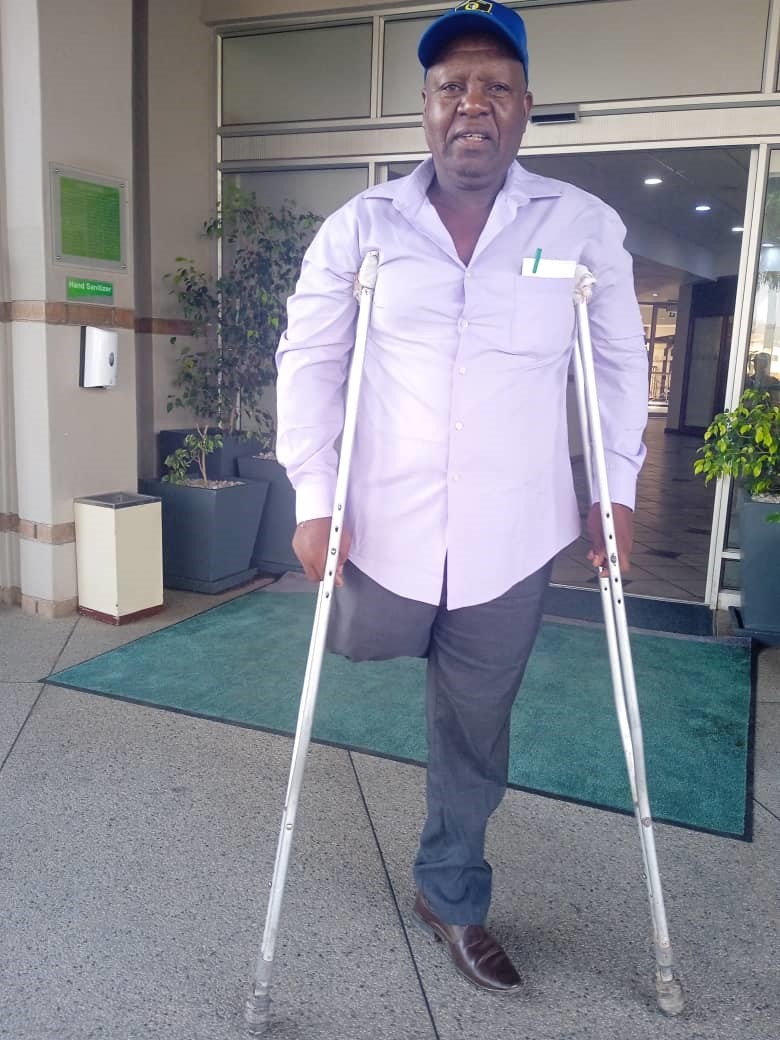
Timothy Mvula
A sudden thud on his left leg was the first sign that his life would never be the same.
“I felt a heavy thud on my left leg, followed by a sharp pain in my thigh. When I looked down, the crocodile’s teeth had sunk into my flesh. My heart stopped. I screamed for help. The whole river turned red — I was swimming in my own blood,” recalls 66‑year‑old father of three, Timothy Mvula .
It was on Sunday, April 8, 2008, at a river in Kamativi, when all hell broke loose for the then 50‑year‑old former mine worker who had simply gone out to look for relish for his family.
“Things were very tough then. I was 50 years old and we had nothing to eat,” he says. “I left home quietly to look for food for my family. I joined my friends who were fishing at the river. Little did I know that my love for my family was going to cost me my leg.”
At first, the fishing trip went smoothly. But in an instant, everything changed.
Mvula had just cast his net as was his usual procedure when a huge crocodile attacked him, dragging him under the water.
“I was supposed to die that day, but God had other plans for me,” he says softly. “The crocodile turned me over and broke my leg instantly. It is true — a crocodile is powerful in water. I wrestled with the reptile, using my hands to pull its jaws apart. That helped, but my leg was already badly damaged.”
As he fought for his life, his friends, terrified, fled from the water, leaving him alone with the predator. His blood, gushing into the river, was likely to attract more crocodiles.
“I don’t know how, but a miracle happened that day,” he says. “I managed to swim to the river bank. That’s when my fellow fishermen finally came back and tried to help me.”
He was rushed to St Patrick’s Hospital in Hwange and later transferred to Hwange Colliery Hospital, where doctors amputated his leg in a bid to save his life.
“While I was in hospital, I was not myself because of the shock,” he remembers. “But I am grateful to church leaders who stood by me, prayed with me and counselled me.”
Mvula is one of many former Kamativi tin mine workers who turned to fishing and scavenging for food after the mine closed in 1994. With no stable jobs, many men and women risked their lives in crocodile‑infested rivers and dams just to put food on the table.
“The mine had closed, and we were desperate,” he explains. “We had families to feed, so we went where we could find fish, even when we knew there were crocodiles.”
Lack of economic activity in Kamativi became one of the major drivers pushing people into dangerous, informal livelihoods. The more the community sank into poverty, the more men and youths crowded around the water bodies, setting nets and lines in full knowledge of the lurking reptiles.
However, local leaders and residents now say the situation has started to change with the coming in of Kamativi Mining Company (KMC). The revival of mining activities has created jobs and stimulated small businesses in the area, reducing the number of people who depend on risky fishing in crocodile‑infested waters.
“The establishment of Kamativi Mining Company has brought a big difference,” says 55‑year‑old resident, Lovemore Banda. “I was one of the people who spent most of my time at the dams, fishing. But now I have a small business. I buy and sell goods because things have changed in this community.”
Banda believes that the creation of formal employment and spin‑off enterprises has saved many people from the fate that befell Mvula.
“People now have options,” he says. “In the past, if you were not at the river, you had nothing. Now some are working at the mine, others are supplying services and goods around the mine. You don’t see as many people risking their lives at the crocodile dams.”
Local leaders, residents and institutions are working together to raise awareness about the dangers of fishing in crocodile‑infested waters and to promote safer ways of earning a living.
The increased presence of organised operations such as KMC has also brought more structured engagement with wildlife authorities and local leadership, opening the door to better reporting, quicker responses to incidents and more coordinated planning around dams and rivers. As livelihoods slowly diversify away from dangerous fishing, the pressure on wildlife habitats has eased, helping reduce direct contact between people and crocodiles.
Community members say reported cases of crocodile attacks in Kamativi have already dropped in recent years, a change they partly attribute to both the renewed economic opportunities and the growing awareness of how to coexist more safely with wildlife.
For Mvula, the scars of that day in 2008 remain, both on his body and in his memory. But as he watches more young people find work and opportunity away from the water’s edge, he believes his story can serve as both a warning and a symbol of hope.
“I lost my leg trying to feed my family,” he says. “If our children can now work safely and earn a living without facing crocodiles, then maybe my pain was not in vain.