By Johnson Siamachira
Harare, (New Ziana) — The lake stretches towards the horizon, its blue waters shimmering beneath the afternoon sun.
At a fishing camp along the shores of Lake Kariba however, the promise of abundance has grown harder to fulfil.
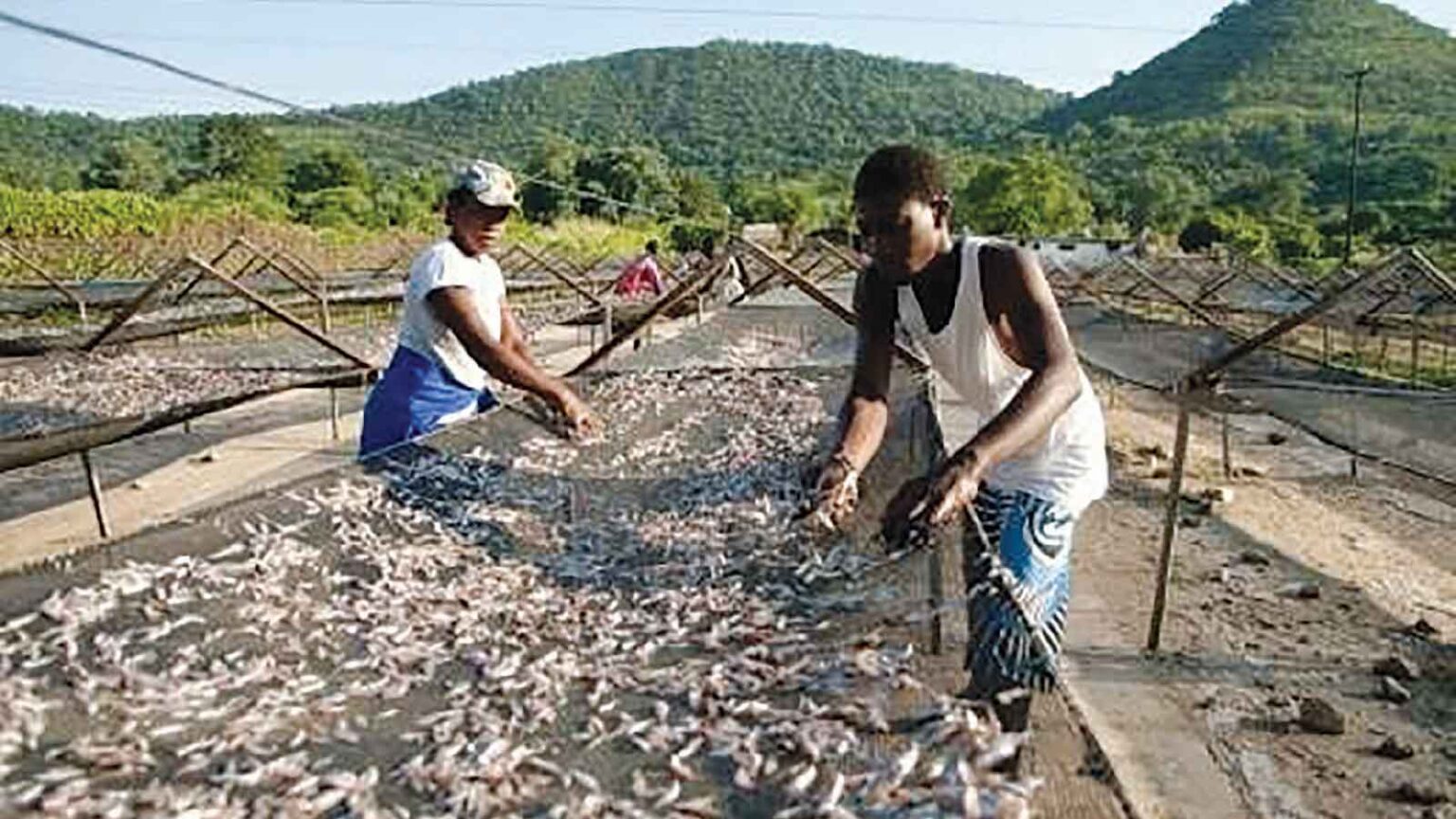
Forkapenta fishers, the small sardine-like fish that once filled their nets in large quantities, each night now brings uncertainty. A poor catch means less money for food, school fees and
Climate change is a very serious issue for kapenta fisheries in Kariba,” said Nesbert
The decline carries consequences beyond fishing camps. Lake Kariba supports livelihoods, food supplies and businesses in Zimbabwe and Zambia while its dam supplies hydroelectric power to both countries. As rising temperatures, changing rainfall and pressure from fishing reshape the reservoir, scientists and industry representatives warn that the future of one of Southern Africa’s most important inland fisheries is becoming increasingly uncertain.
A fishery under pressure
Zimbabwe’s kapenta industry recorded poor catches in 2026, including August, traditionally one of its peak fishing months, according to the Food and Agriculture Organization (FAO) of the United Nations.
Data cited from the Zimbabwe Parks and Wildlife Management Authority(ZimParks) show annual kapenta production falling from about 5,950 tonnes in 2020-21 to 5,175 tonnes in 2023-24. That is far below the more than 30,000 tonnes recorded annually during the 1990s.
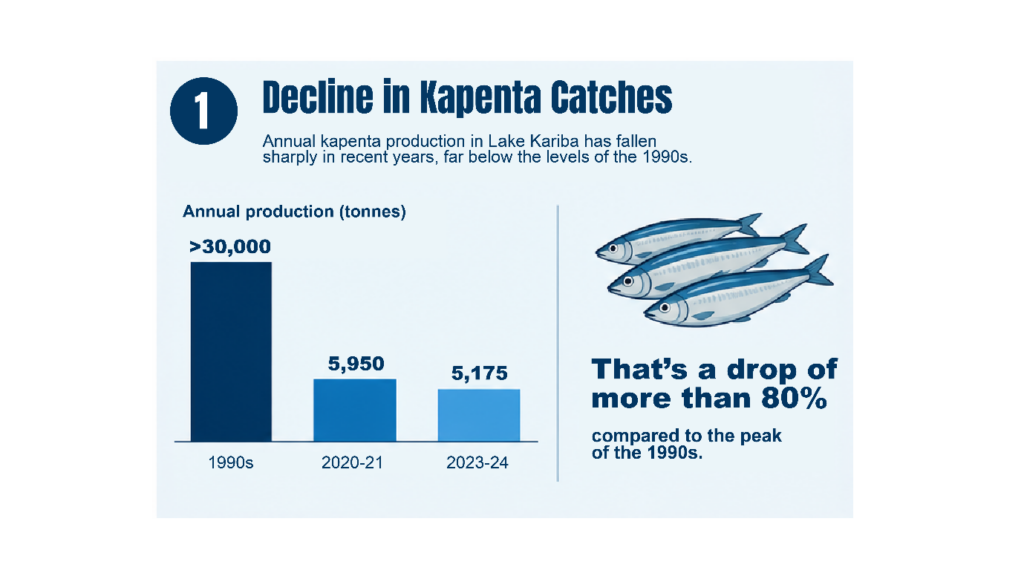
There has been a significant decline in kapenta fish production in Lake Kariba. Source: ZimParks.
The figures indicate a fishery that has lost much of its former productivity. But they do not, on their own, establish how much of the decline comes from climate change, fishing pressure,
Published research provides a longer view. A 2011 study by a team of aquatic ecologists and climate change experts of Mzime Ndebele-Murisa, Emmanuel Mashonjowa and Trevor Hill examined climate records, water levels and kapenta catches from 1963 to 2008. It found that production had declined significantly since 1974, while rainfall decreased and evaporation increased. The researchers identified lake water levels as the strongest climate-related influence on catches.
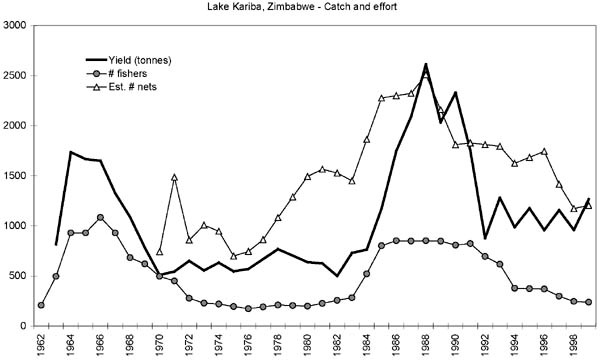
Lake Kariba kapenta fish stocks from the 1960s. Source: FAO
Declining “Kapenta depends on the lake’s wider aquatic food chain,” said Dr. Lightone Marufu, an aquatic ecologist and lecturer in the University of Zimbabwe’s Biological Sciences Department. He also represents the department at the university’s Lake Kariba Research Station.
“When environmental conditions change, the effects can travel from microscopic organisms to fish, fishing boats and family incomes,” he said.
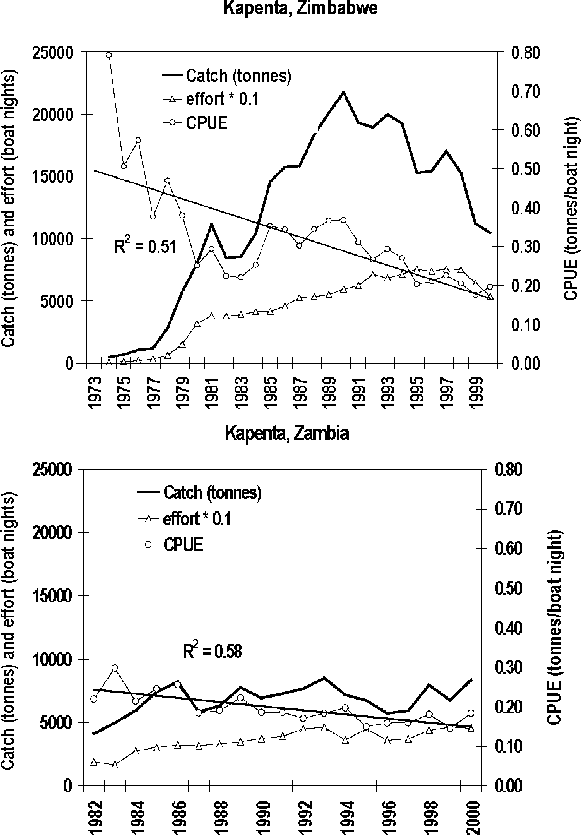
Kapenta fish catches in Lake Kariba (Zambia and Zimbabwe). Source: FAO
When the water changes
Kapenta feeds on tiny aquatic organisms, including plankton. Changes in the lake’s temperature, water levels and nutrient supply can therefore affect the fish even before a fishing net enters the water.
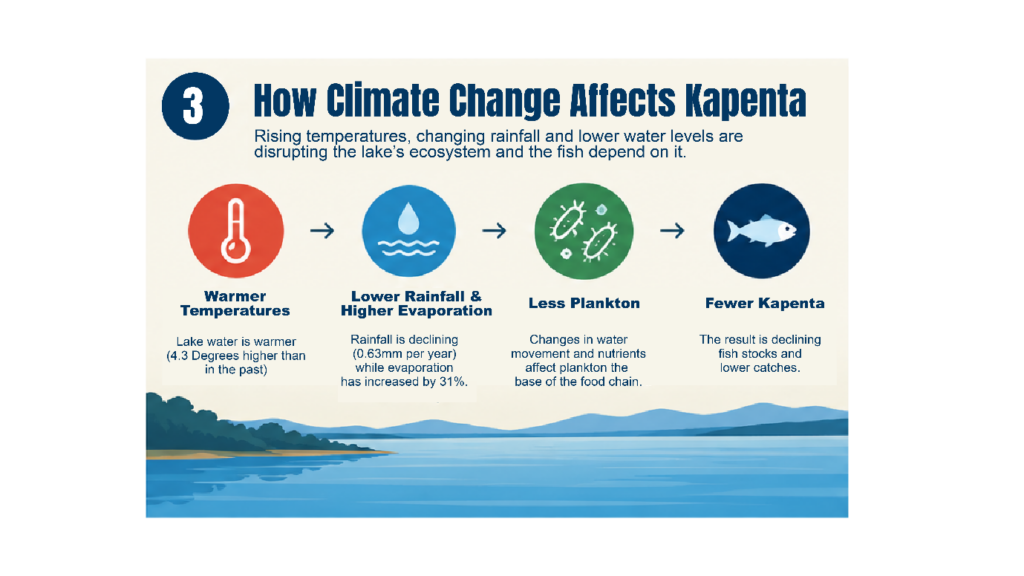
Changes in the lake’s temperature, water levels and nutrient supply can affect fish.Source: Johnson Siamachira Own Creation.
Research has documented warming in Lake Kariba. A 2014 University of Zimbabwe study found that the mean temperature through the lake’s water column in July 2011 reached 22.9 degrees Celsius – 4.3 degrees higher than the average recorded for the same month between 1987 and 1999. It was also 5.1 degrees higher than the average measured in 1967-
The 2011 climate study found that evaporation around Kariba had increased by 31per cent since 1963, while rainfall declined at an average rate of 0.63 millimetres per year. It also linked changing temperatures and water levels to conditions that could affect the lake’s nutrient supply and kapenta production.
The lake’s water does more than provide a home for fish. It carries nutrients that support plankton, which in turn supports kapenta. When warming changes the movement of water between the surface and deeper layers, it can affect how those nutrients circulate.
A 2013 climate modelling study projected that Lake Kariba could become warmer and drier. The models estimated rainfall decreases of between 3 per cent and 27.46 per cent and temperature increases of about 3.17 to 3.42 degrees Celsius under the scenarios examined. The researchers warned that kapenta production could continue to decline if other conditions remained unchanged.
Those projections describe possible future conditions, not measurements of what has already happened. They nevertheless point to a difficult question for fisheries managers: how can they protect fish stocks when both the climate and fishing pressure are changing?
Climate change is not the only challenge.
Too many nets, too few fish
Zimbabwe and Zambia have agreed on a sustainable limit of 500 kapenta fishing rigs — 275 for Zimbabwe and 225 for Zambia. Industry representatives and authorities have raised concerns about fishing effort exceeding that threshold.
“Such unsustainable fishing practices and effort can collapse the industry,” Dr Marufu said.
The Zimbabwe Parks and Wildlife Management Authority suspended new kapenta fishing licences in 2020 after fishing effort exceeded sustainable levels. Authorities have also adjusted minimum fishing depths temporarily to help operators cope with low water levels.
Mapfumo said declining catches had forced some processing businesses to close, reducing employment and weakening Kariba’s economy.
“Most of the industries we used to see are no longer there,” he said.
Research on small-scale fishers in Lake Kariba’s Sanyathi fishing basin found that 92 per cent of surveyed fishers were aware of climate change and associated it with changes in fish catches. The study also showed why local observations matter: perceptions of climate change do not always match the direction of trends in every available climate record.
A lake that needs better information
Dr Marufu called for regular fish stock assessments, stronger cooperation between Zimbabwe and Zambia and coordinated monitoring of fishing rigs.
Satellite tracking could help authorities identify fishing in protected areas, he said, while regular engagement among researchers, fishing communities, government ministries and industry could improve management.
The University of Zimbabwe’s Lake Kariba Research Station and Biological Sciences Department continue to support aquatic research and training. Dr Marufu said the university’s aquatic sciences and ecology programme could help develop expertise to address the lake’s fisheries challenges.
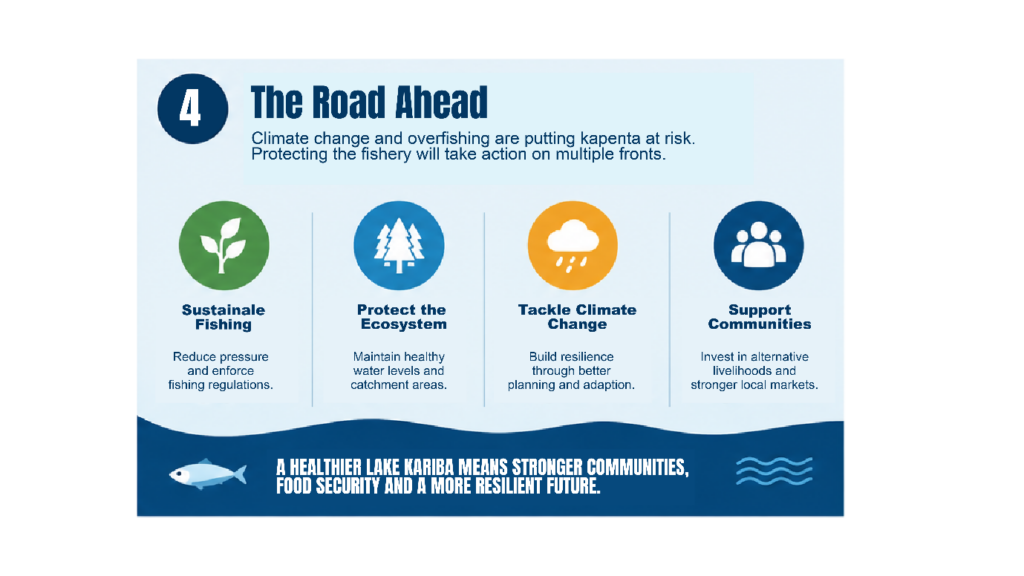
Protecting the fishery needs action from multiple stakeholders. Source: FAO
Lake Kariba has also shown that recovery in one measure does not necessarily mean recovery in another. The Zambezi River Authority reported usable storage of 43.98 per cent on August 24, 2026, compared with 20.72 per cent on the same date in 2025. But a higher water level does not automatically mean that fish stocks have recovered.
For Kariba’s fishing communities, the lake’s future will be measured not only in metres of water, but in the number of fish returning to the nets.
The warning from the lake is simple: when the water changes, everything that depends on it must change, too.
As the effects of climate change accelerate, the fate of Lake Kariba serves as a stark warning for other inland water bodies across Africa.
“We can’t keep treating Lake Kariba like a bottomless resource,” Dr Marufu said. “If we don’t act now, we risk losing everything —our fish, our power, and our future.”