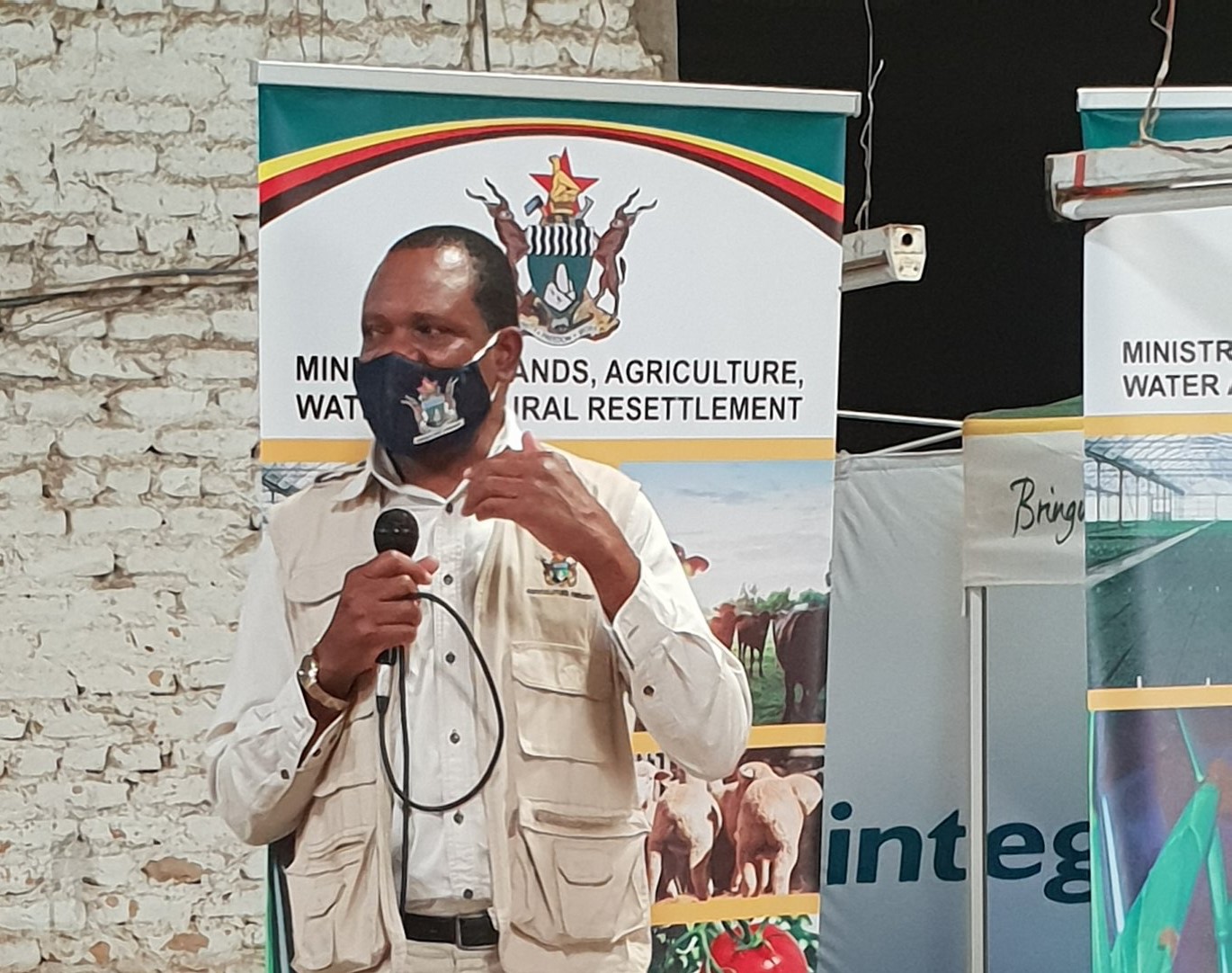
Harare (New Ziana) –The Zimbabwe government and the private sector should support communal and small-holder farmers for the country to attain Vision 2030, since it is hinged on rural development through agrarian revolution.
Lands, Agriculture, Fisheries, Water and Rural Development Minister Dr Anxious Masuka said this on Wednesday while officially opening a three-day forum on agriculture investment dubbed Hand-in-Hand Initiative being held in the capital.
The Food and Agriculture Organisation (FAO) is sponsoring the forum.
Dr Masuka said Zimbabwe is a developmental State, which means the government should be both a facilitator and an active participant.
“So the State must play a dual role. It must be an active player and also an active facilitator for the private sector investment to come in,” he said.
“As an agro-based economy, it is agricultural development that must cause rural development, rural development must catalyse the attainment of Vision 2030,” he said.
He said there is a strong link between agricultural development, rural industrialisation, rural development and Vision 2030 which should be articulated correctly in order to convince investors to channel resources so that people can be lifted out of poverty.
There is also need to consistently and persistently articulate the link through various investment proposals.
“This is indeed the basis of rural development 8.0 which is a cocktail of nationwide impact-based and outcome oriented interventions focused on two aspects of this quadri-agriculture space focused on communal and
small-holder farmers, 61 percent of our population, some 9.2 million people.
Zimbabwe has set itself a target to attain an upper middle class economy by 2030.
Rural development 8.0 comprises the Presidential Climate Proofed Input Scheme, Presidential Cotton Input Scheme, Presidential Blitz Tick Grease Scheme, Presidential Rural Development Program, Presidential Community
Fisheries Scheme, Presidential Poultry Scheme, Presidential Goat Scheme and the Vision 2030 Accelerator Model.
Dr Masuka said he expects a wide array of provincial plans clearly indicating the different ways these interventions will uplift communities using a value chain approach, from ideation to selection,through to implementation.
He said the government is reviewing the agriculture and food systems transformation strategy and has since selected volunteer private sector champions to assist it in this regard.
As a result, he said, there is need for a data driven science-based mapping of each of the country’s provinces in terms of the agriculture and food systems transformation strategy, analysing the gaps and proffering realistic and practical investment opportunities, to bridge the gaps for the attainment of Vision 2030.
Speaking at the same occasion, FAO sub regional coordinator for Southern Africa and representative to Zimbabwe, Lesotho and Eswatini, Dr PatriceTakoukam said, his organisation remains committed to providing technical
support to the Government of Zimbabwe.
Dr Takoukam said FAO also greatly appreciates its collaborative partnership with the Ministry and other key stakeholders.
“As we all know, our collective objective is to defeat poverty, hunger and malnutrition and the Hand-in-Hand Initiative provides a valuable framework to contribute to the attainment of this objective,” he said.
“Through facilitation of SDG (Sustainable Development Goal) aligned Investments into Agro-Food Systems, the country is better able to attain its socio-economic objectives as well.”
New Ziana