

By Johnson Siamachira
Harare, (New Ziana) – Small-scale dairy farming is a vital component of Zimbabwe’s integrated crop-livestock production systems and the national economy, with about 67 per cent of rural households depending on the industry as a vital source of income and socio-economic development.
Although milk is the primary product, male calves and old cows are also a key source of meat and income. Demand for high quality meat and milk is rapidly increasing in the country, creating significant opportunities for smallholder dairy farming families.
According to the National Competitiveness Commission (NCC), the dairy sector is a significant employer, providing direct jobs to 30 000 people and indirectly to 1.3 million households, National annual milk production increased by 52.5 per cent from 75.4 million litres in 2018 to about 115 million litres in 2024, against an estimated national demand of about 130 million litres per annum.
This indicates a gap of about 15 million litres, which is being supplemented by imported raw milk from Mozambique and powdered milk from India and South Africa, among others, the NCC says.
According to the Dairy Sector Strategic Plan (2021-2025), Zimbabwe produced over 260 million litres per year at its peak during the early 1990’s. The dairy sector has great potential to grow, however there is need to address challenges affecting farmers which include high cost of production, attributed to the general macroeconomic conditions characterised by exchange rates losses, high cost of compliance, high cost of borrowing and inadequate foreign currency.
Stockfeed,also, is a major cost in dairy production, accounting for 70 per cent of raw milk production. As part of the process of enhancing milk production, a membership-driven organisation, the Zimbabwe Association of Dairy Farmers (ZADF) is working with dairy stakeholders, including the government, to address major factors contributing to the supply gap.
Among other key stakeholders, ZADF works with milk collection centers (MCCs) countrywide who comprise the 4 528 registered small-scale dairy farmers in the country, 36 per cent of whom are females.
The average herd size is four to five dairy animals in the rural areas and productivity is low with less than five litres of milk per cow per day. Marirangwe MCC is one of the initiatives fighting the dairy sector challenges.
Established in 1986 by a group of 10 small-scale dairy farmers in Seke district, Mashonaland East province, membership has since grown to 50 farmers, with 45 currently in production, and the farmers milking dairy crosses and pure dairy cows.
According to the ZADF, at its inception, the milk collection centre used to produce an average of 9 000 litres per month and now, with increased production, it is the largest of the MCCs in terms of milk procurement from farmer aggregators.
The group-based approach has allowed the farmers to negotiate better prices for their milk, ensuring they receive a fair return on their labour and investments. ”Our milk target for the year 2025-2026 is one million litres of milk, up from 773 962 litres of milk last year,” said Marirangwe Dairy Farmers Association secretary, William Mazingi,, who is also a dairy farmer in the area, adding the MCC plans to venture into value addition and start producing cheese, yoghurt and other dairy products.
For farmers like Charles Sibanda, the MCC chairperson, the adopted simple agricultural practices made a significant difference, with participants recording not only improvements in their animals’ health, but noticing sizeable increases in milk production, ,as much as an extra litre per animal each day, meaning more income for the household.
Currently, each Marirangwe farmer is milking an average of 15 litres of milk per cow per day. ”By working together, we have been able to leverage on collective bargaining power to secure more favourable deals with milk processors and distributors,” explained Mazingi, adding, “Government supported us with inputs to grow silage and this has increased milk production in the past three years.”
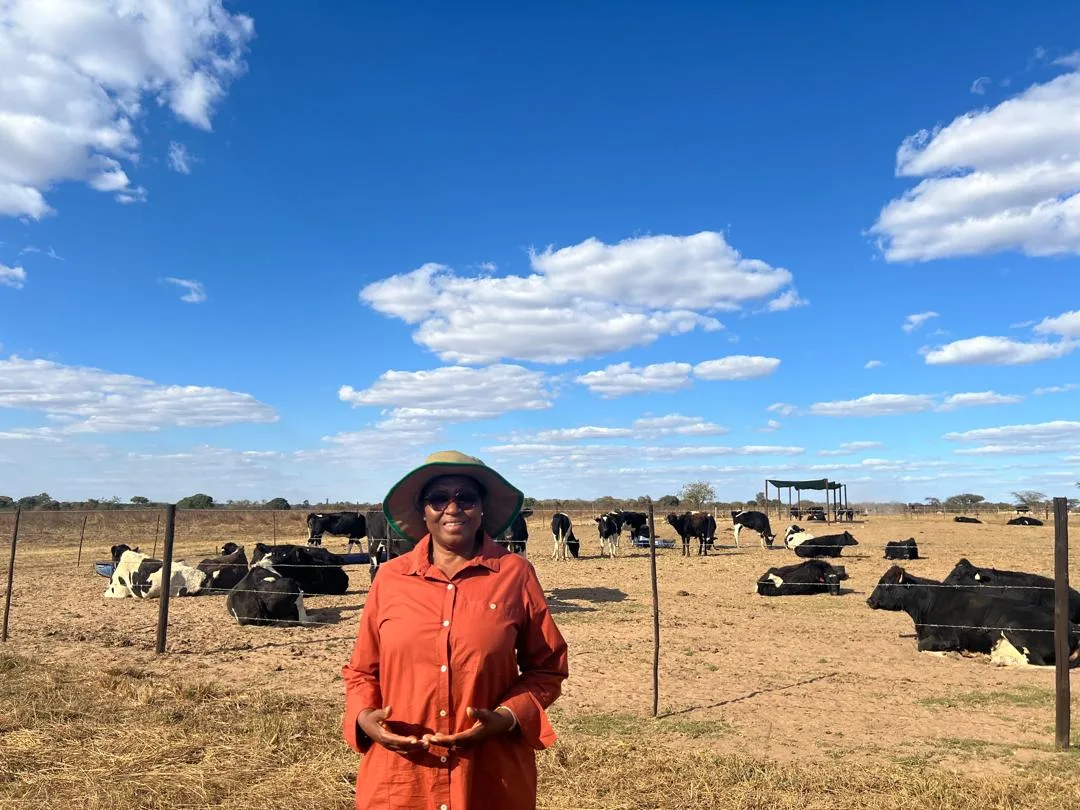
Dr Dorothy Mutizwa is a dairy farmer and Director of Rainbow’s End Farm, which she jointly owns with her husband, Professor Naison Mutizwa-Mangiza. She is responsible for operations on the 118 – hectare farm located in the Manyame district of Marirangwe.
In 2022, Dr Mutizwa graduated from being a small-scale dairy farmer to a medium-scale/large- scale dairy farmer. With a total dairy herd of over 140 animals, the Mutizwa family prioritises efficiency, nutrition, and long-term sustainability.
From silage planning to structured breeding and hands-on animal health practices, this is more than just a farm, it is a well-run milk production system that shows what is possible with passion, hard work, discipline, data-based management and commitment.
From an undeveloped farm in 2020, Rainbow’s End Farm now has electricity from the national power utility, Zimbabwe Electricity Supply Authority, 15 KVA solar system and a 50KVA generator, to support a 10-point fixed milking machine in the milking parlour, milk cooling tanks, water pumping and lighting on the farm.
Additionally, for animal feed, the farm grows about 30 hectares of maize during the rainy season and two hectares of maize and velvet beans and hemp under drip irrigation for silage.
Antonnette Chingwe, the ZADF Principal Policy Officer said the gap in supply is an opportunity for smallholder dairy farmers to increase household agricultural incomes.
Zimbabwe’s dairy genetic improvement initiatives are also gaining momentum, driven by both government and private sector investments. Through the Dairy Revitalisation programme, the government and private sector have partnered in distributing in-calf heifers to smallholder dairy farmers, aiming to increase milk production.
”The country is also importing high-quality semen to enhance dairy genetics.,” said Takudzwa Chimuto, ZADF Dairy Revitalisation Program Officer. ”Thie dairy sector growth signals not only the strength of current interventions but also the sector’s potential to reach full self-sufficiency.
Now more than ever, it’s crucial to consolidate these gains by scaling up support mechanisms, addressing sector-specific needs, and unlocking financing to future-proof dairy production,” said Dr Renneth Mano, Livestock and Meat Advisory Council Executive Administrator.
He added that with the national requirement standing at 130 million litres per annum, Zimbabwe is gradually closing the gap and reducing its reliance on imports. The growth has translated into tangible economic benefits, including a reduced import bill, increased availability of locally processed dairy products, and improved foreign currency retention.
As stakeholders continue to enhance the dairy value chain, there is optimism that Zimbabwe will unlock the full potential of the sector and support its role in driving economic prosperity.
New Ziana