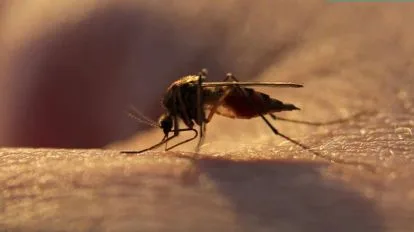
By Johnson Siamachira
Harare, (New Ziana) — At 8 a.m., the night chill still hangs over Nyamhunga Clinic in Kariba town when Priscilla Katsande arrives carrying her for-year-old son against her chest.
His body is hot. He is shaking with fever.
At the clinic registration window, Katsande hesitates. Before her son can receive care, she must find money for a consultation card and, later, medicines she may not be able to afford.
For Katsande, malaria is not simply a disease carried by mosquitoes. It is a race between a child’s rising temperature and a family’s ability to pay.
“The main problem is that when you go to the clinic, you first pay for the consultation card,” Katsande says. “I don’t have that money, so most of us end up staying at home. That’s why people delay.” Kariba is one of Zimbabwe’s malaria hot spots.
Her experience illustrates a less visible dimension of Zimbabwe’s malaria resurgence: prevention and treatment can depend not only on mosquito control and medicines, but also on whether families can reach care quickly enough.
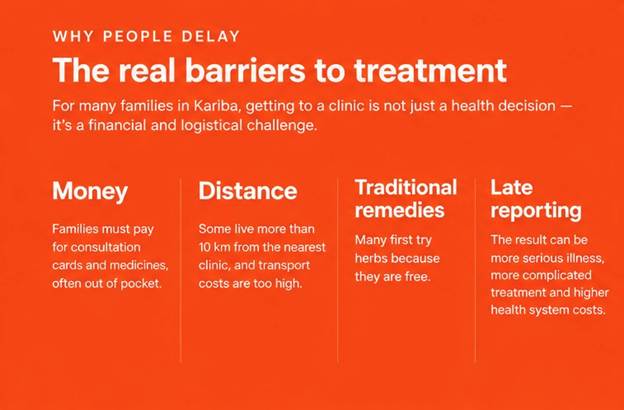
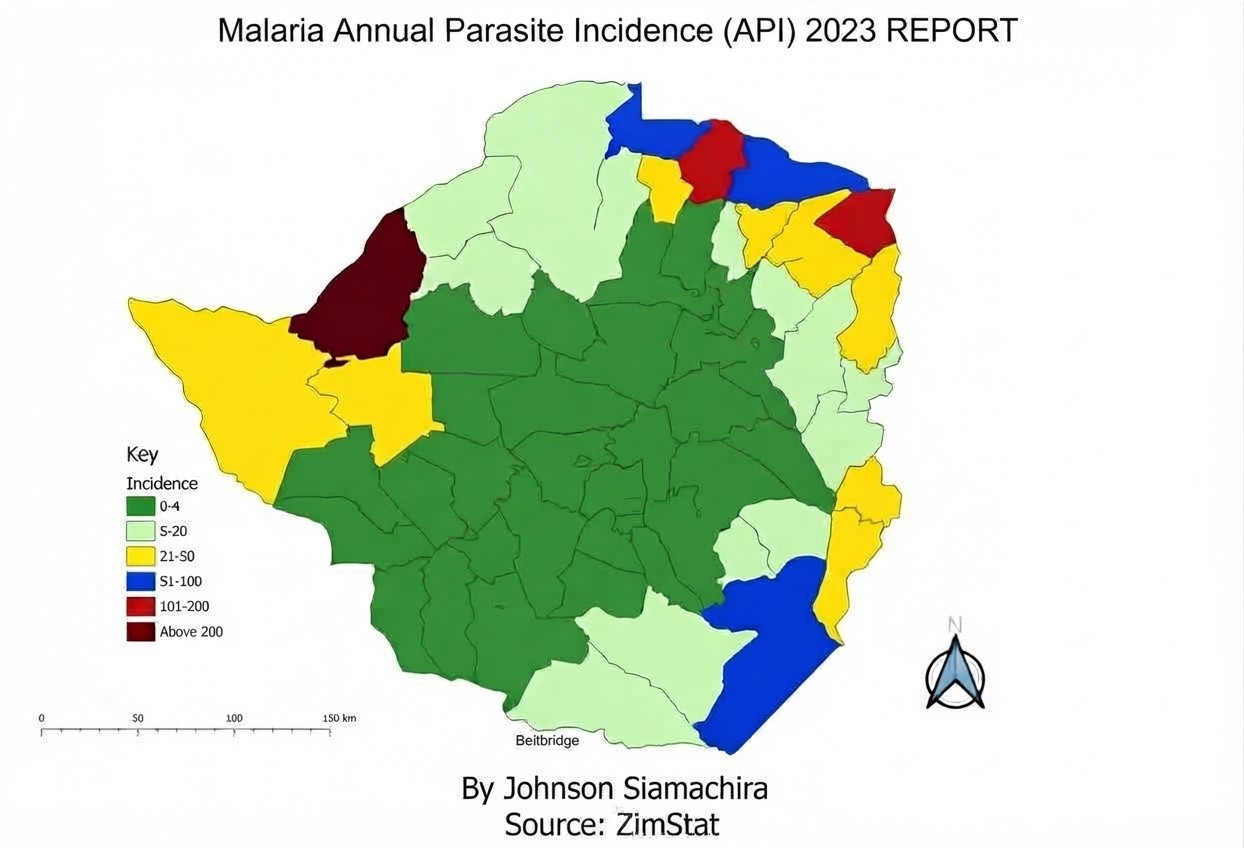
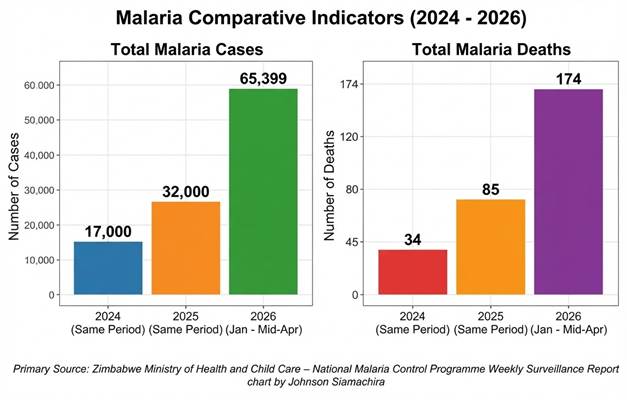
Chart: Johnson Siamachira. Source: Ministry of Health and Child Care.
The numbers behind the fever
Zimbabwe entered 2025 facing a sharp increase in malaria transmission. By epidemiological week 27, ending July 6, the country had recorded 126,229 confirmed malaria cases and 358 deaths, according to a World Health Organization(WHO) outbreak bulletin. Cases were 296.8 per cent higher than during the same period in 2024, while deaths were more than five times higher.
Earlier in 2025, Africa Centres For Diseases Control (CDC) reported 111,998 cases and 310 deaths by epidemiological week 23, compared with 29,031 cases and 49 deaths during the same period in 2024. The agency linked the increase partly to prolonged rains and greater human exposure through activities such as fishing, gold panning and artisanal mining.
Malaria has always been endemic in Zimbabwe, but the current surge marks a troubling turning point. “The data is alarming,” says Dr. Memory Mapfumo, an epidemiologist at the Africa CDC and Prevention. “Prolonged rains have created ideal conditions for mosquito breeding, while
The figures are snapshots from different points in the same outbreak rather than competing totals.
WHO’s 2024 Zimbabwe country profile recorded 248,699 presumed and confirmed cases and 317 indigenous deaths, underscoring the country’s continuing malaria burden even before the 2025 surge.
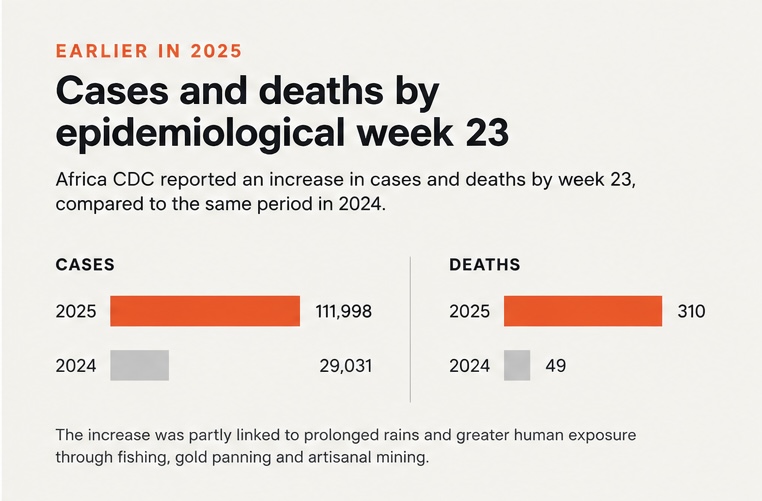
Infographic by Johnson Siamachira. Source:Africa CDC.
In addition, inadequate vector control measures, including gaps in indoor residual spraying (IRS) and limited access to insecticide-treated nets (ITNs), have left communities exposed. Professor Sungano Mharakurwa, director of Africa University’s Malaria Institute, says that “the funding cuts from the U.S. have crippled vital programmes, leaving us vulnerable when we should be strengthening our defences.”
These funding disruptions, particularly the withdrawal of U.S. aid in early 2025, have had devastating effects. “The Zento mosquito surveillance programme was showing promising results before the funding cuts,” Prof Mharakurwa explains. “Now, we are witnessing a rebound of cases that we had managed to suppress.”
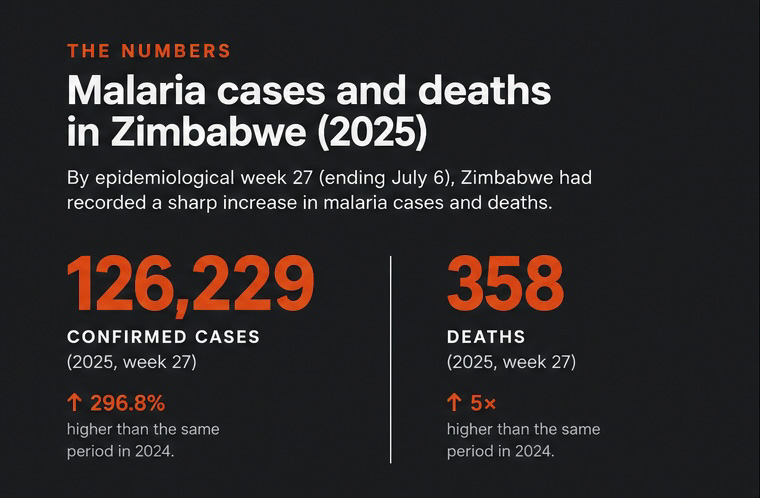
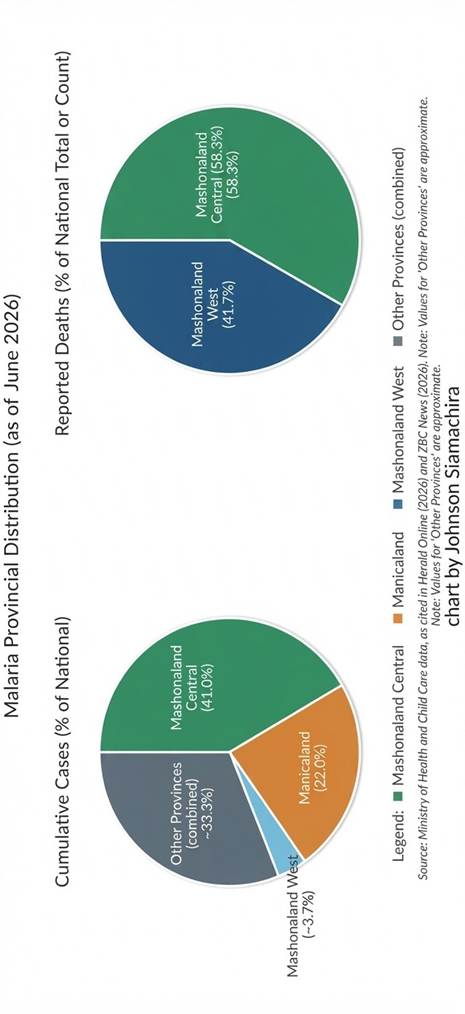
Infographic by Johnson Siamachira. Source: Ministry of Health and Child Care
He added that since the Zento mosquito surveillance programme began in Manicaland Province, there had been a marked reduction in malaria cases and it was about to be extended when the cuts came.
Prof Mharakurwa said: “The malaria was back with a vengeance straight after, and numbers of cases that were waning rebounded in 2025, surpassing levels that had ever been seen since the beginning of the project.”
Kariba District Medical Officer Dr. Godwin Muza says late reporting remains one of the biggest challenges.
“We are in the peak malaria season right now,” Dr Muza says. “The main challenge we face is late reporting.”
When distance becomes a health risk
For Katsande, the problem is money. For others, it is distance.
Rudo Mabhande, another Nyamhunga resident, says some families first turn to traditional remedies because they are free.
“Some of us first try herbs at home because they are free,” she says. “We only go to hospital or clinic when the herbs don’t work.”
In Gache Gache, a largely fishing community, Christina Banda faces another obstacle: geography.
“The nearest clinic is over 10 kilometres away and transport costs more than I can afford,” she says. “By the time I get the money, the fever is already bad.”
The pattern matters because malaria can deteriorate rapidly, particularly in young children.
Dr Muza says patients who arrive late can require more complicated treatment and consume more health-system resources.
A disease shaped by climate and livelihoods
Malaria transmission follows an ecological clock.
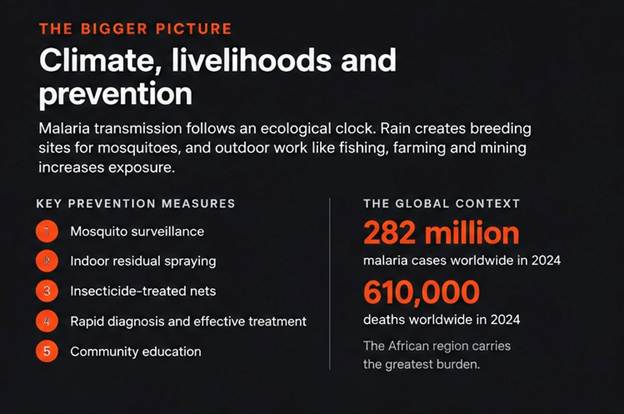
Infographic by Johnson Siamachira. Source: World Health aOrganization.
Rain creates pools and other breeding sites for Anopheles mosquitoes, while fishing, farming and other outdoor livelihoods can increase people’s exposure during mosquito activity.
Africa CDC has warned that changing rainfall patterns and human activities are increasing malaria risks in Southern Africa. The agency has also highlighted the need for sustained surveillance, vector control, environmental management and cross-border cooperation.
Dr. Merawi Aragaw, head of the Africa CDC’s Surveillance and Disease Intelligence, warns, “As climate change accelerates, we face a growing threat from malaria-carrying mosquitoes. This is not just a local issue; it requires coordinated international efforts to mitigate.”
Zimbabwe’s challenge is therefore larger than treating individual fevers. It must keep several defences operating at the same time: mosquito surveillance, indoor residual spraying, insecticide-treated nets, rapid diagnosis, effective treatment and community education.
Zimbabwe’s Malaria Control Programme is also operating against a global backdrop in which progress has become fragile. WHO estimates that 282 million malaria cases and 610,000 deaths occurred worldwide in 2024, with the African region carrying the greatest burden.
The price of waiting
For Katsande, those global numbers have a face: her son, feverish in her arms.
The distance between a mosquito bite and a hospital bed can be measured in hours. But in Kariba, it can also be measured in transport fares, consultation fees, medicine costs and the decision to wait one more night.
That is why the malaria story cannot end at the mosquito net.
It begins there, but continues through the clinic gate.
Health authorities have been strengthening malaria surveillance and supplies, while public-health experts emphasise early testing and treatment, prevention and community participation. Zimbabwe’s long-term objective remains malaria elimination, consistent with the global 2030 elimination agenda.
As evening settles over Lake Kariba, mosquitoes begin their nightly search for blood.
Inside Nyamhunga Clinic, the counter-race begins again, between a parasite multiplying inside a patient’s blood and a health system trying to reach that patient before a fever becomes a crisis.
For Katsande, the choice should be simple: get a sick child tested and treated.
But when money, distance and fear stand between a family and the clinic, even that simple choice can become a gamble.