
By Johnson Siamachira
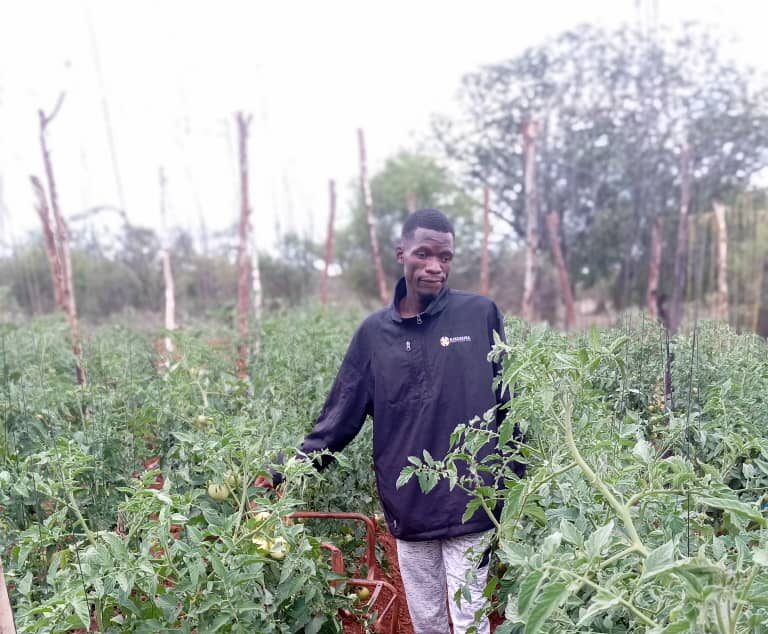
Harare, (New Ziana) — Heat shimmers off the dry Matabeleland South scrubland, but inside Brian Mavhinjeva’s makeshift greenhouse, thousands of tomato and cabbage seedlings push through dark growing media in neat plastic trays, defying the arid landscape outside.
The 26-year-old moves between cabbage rows with the practiced calm of someone who has already watched an entire crop die —and chose to start again.‘’Farming is one of the highest-risk ventures you can enter,’’ Mavhinjeva said, brushing soil from his hands. ‘’You fail, you invest again, you lose devastatingly to a point of giving up —but you try again. You learn as you go until it opens up for you.’’
The philosophy carried him from a backyard vegetable patch in Bulawayo, to a two-location horticultural enterprise spanning Insiza North district and the country’s second largest city—all before his 27th birthday.
His story sits at the nexus of one of Zimbabwe’s most stubborn development challenges: unlocking agricultural finance for young people in a country where 67 per cent of the population lives in rural areas, banks demand collateral smallholder farmers cannot provide, and agriculture contributes 17 per cent of Gross Domestic Product yet remains chronically underfunded at the grassroots level.
The Zimbabwe Agricultural Development Trust’s (ZADT) CAUSEWAY project – funded by the Swedish and British embassies – is attempting to close that gap, one bankable
Agriculture employs nearly 70 per cent of Zimbabwe’s workforce, and smallholder farmers produce 70 per cent of the nation’s maize and tobacco, according to the World Bank and the Food and Agriculture Organization of the United Nations. Yet formal agricultural finance remains stubbornly out of reach. Collateral requirements, limited credit histories, and institutional risk aversion lock out the very producers who feed the country. Women and youth —52 per cent and 67 per cent of the population respectively— bear the brunt of that exclusion.
ZADT launched CAUSEWAY in August 2023 to train 6,000 youth and 5,000 women entrepreneurs over three years, pairing financial literacy training with revolving credit facilities and market linkages. A targeted component mentors 300 final-year students at agricultural colleges nationwide, incubating enterprises before graduates even leave campus.
Mavhinjeva encountered the programme during his final semester at Esigodini Agricultural College in 2024. A neighbour who had studied there first planted the idea of formal agricultural training; ZADT’s financial literacy workshops watered it.
’That training was an eye-opener,’’ he said. ‘’Project proposal writing, budgeting, how to approach financial institutions—suddenly the dream of commercial farming had a road map.’’
He and four classmates formed the Five Star Farmers’ group, pitched a seedling nursery and vegetable production plan against competing student teams, and won a start-up grant of US$1,894 through ZADT’s CAUSEWAY Project grant funding component supported by the Swedish Embassy.
However, reality hit fast when they started implementing the project at the college. A scorching heatwave and critical water shortages destroyed 8,000 cabbage seedlings. Excess rains rotted ripening crops. Personality clashes tested a team of ambitious young people with shared vision but different ideas.
‘’Managing a bigger project came as a blow right in the face,’’ Mavhinjeva recalled. ‘But our mentors— ZADT staff, college lecturers — walked with us step by step through every decision.’’
The group survived, graduated in October 2024, and split US$700 in profits plus assets worth US$200, including 150 metres of poly pipe, 1,000 metres of drip tape, and two bags of 50 kg ammonium nitrate fertiliser for each member.
Armed with these modest assets, Mavhinjeva faced a crossroads. A seed company offered him a salaried position he took up. Simultaneously, he launched a small nursery at home—until a devastating loss of seedlings worth US$350 forced a reckoning.
‘’I sat down, evaluated the opportunity costs, and realised the business needed my full attention,’’ he said. ‘’I resigned.’’
Today, Kinder Green Enterprises—the brand Mavhinjeva built—operates from Levy Dale in Insiza North district and a second site in Bulawayo. The nursery holds 12,000 seedlings on trays and over 250,000 on seedbeds, producing hybrid tomatoes, cabbages, evergreen covo and onions. He supplies backyard gardeners, smallholder farmers, and commercial farmers across Gwanda, Bulawayo, Esigodini, Filabusi, and beyond.
But seedlings alone do not define the enterprise. Mavhinjeva bundles free agronomic advice with every sale, offers landscaping services — he has beautified five residential properties in Bulawayo’s Tshabalala Extension — and fields a steady stream of phone calls from tomato farmers seeking production guidance.
‘’We don’t just sell seedlings and stop there,’’ he said. ‘’We extend marketing assistance and advice. No one gets left behind.’’
Smallholder farmers should now shift from its current largely informal status into the formal business sector, with a more structured system that particularly targets the young.
The ripple effects reach further. Several young farmers he mentored have accessed ZADT training and secured their own funding. Some mentored female clients now run independent seedling houses, a trend Mavhinjeva celebrates.
ZADT Chief Executive Officer, Godfrey Chinoera framed the model’s significance in national terms: ‘’By linking smallholders to finance, markets, training and technical support, we’re unlocking inclusive rural transformation. Youth like Brian are not just beneficiaries —they are leaders of economic growth.’’
Chinoera adds: ‘’When it works, smallholder agribusinesses can help rebrand agriculture as an attractive career, especially for the youth.
The CAUSEWAY’s numbers bolster that claim. Seventy-five per cent of trained and funded borrowers accessed formal credit for the first time. Business turnover among trained women and youth grew 139 per cent. Financial institutions have unlocked US$452,200.00 in complementary lending — up from zero in year one.
Challenges persist. Mavhinjeva’s greenhouse falls below commercial standards. Demand outstrips his supply of trays and growing media. Transport logistics across scattered rural markets strain thin margins. Company registration and tax clearance paper work — essential for legitimacy— remain unresolved.
Yet on a continent where the African Development Bank estimates the agricultural financing gap exceeds US$100 billion annually, a young Zimbabwean who turned a US$1,894 college grant into a multi-million enterprise, serving five districts offers a potent counter narrative to the assumption that rural youth will inevitably flee to cities or abroad for greener pastures.
‘’Agriculture is evolving every day. It should be used to make money and create wealth,’’ Mavhinjeva said, surveying trays of onion seedlings destined for the coming season. ‘’My goal is to occupy the whole value chain — from seedling production to value addition. And, I want the love and passion for farming to spread to the next generation of youth farmers, so food security and rural commercial farming is addressed for good.’’
As rain clouds gather over Insiza North District, promising another good planting season, the young agripreneur bends back to work — proving that with the right seed capital, mentorship, passion and endurance, Zimbabwe’s soil yields more than just crops.
It yields the future.
New Ziana