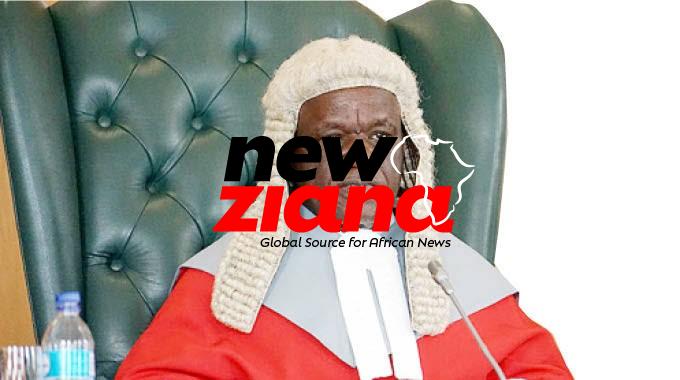
Harare, (New Ziana) – Government has paid glowing tribute to retiring Chief Justice Luke Malaba, describing his tenure as one marked by dedication to constitutionalism, institutional reform and the modernisation of Zimbabwe’s justice delivery system.
Speaking at Justice Malaba’s final Constitutional Court sitting and farewell ceremony held in Harare on Thursday, Minister of Justice, Legal and Parliamentary Affairs Ziyambi Ziyambi said the Government was grateful for the veteran jurist’s immense contribution to the country’s judiciary and the strengthening of constitutional governance.
Justice Malaba officially retires at midnight on Thursday after a legal career spanning more than four decades and a tenure that saw major reforms within the judiciary.
Addressing judges, legal practitioners and Government officials during the farewell proceedings, Ziyambi described the occasion as both solemn and historic, saying it offered the nation an opportunity to reflect on Justice Malaba’s distinguished service to the laws and the people of Zimbabwe.
“We have come today to honour Chief Justice Malaba on the occasion of his retirement from judicial office.
“This is a solemn occasion that invites us to look back at a judicial career marked by dedication to the Constitution and deep commitment to the transformation of justice delivery,” he said.
Ziyambi said while the judiciary’s traditional role remained adjudication and interpretation of the law, modern justice systems now required courts to be efficient, technologically responsive and accessible to citizens across the country.
He said Justice Malaba’s leadership coincided with the Second Republic’s broader reform agenda, particularly under the National Development Strategy 1 framework, which prioritizes governance, public confidence in institutions and access to justice.
“The judiciary, under the leadership of the Chief Justice, responded to that national expectation with serious commitment. Court infrastructure was expanded and decentralization of court services gave practical meaning to access to justice because justice that is physically distant from the people remains difficult to reach,” said Ziyambi.
He hailed the digitalization of Zimbabwe’s courts as one of the most significant reforms undertaken during Justice Malaba’s tenure.
“The Integrated Electronic Case Management System moved our courts from paper-based processes towards electronic systems. Justice delivery became one of the first public services to undergo this level of digital transformation in Zimbabwe,” he said.
Ziyambi noted that the reforms were not merely technological advancements, but constitutional and people-centred initiatives aimed at making courts more accessible, transparent and responsive to the public.
He said Justice Malaba consistently championed institutional efficiency and viewed the courts not only as legal institutions, but as public institutions established to serve ordinary citizens.
“You insisted on institutional efficiency within the courts of Zimbabwe. You understood that the authority of the judiciary is strengthened when the public has confidence that cases are managed fairly and court services are properly administered,” he said.
He also commended the cooperation between the judiciary, legislature and executive during Justice Malaba’s tenure, saying constitutional institutions had worked together while respecting the doctrine of separation of powers and judicial independence.
“On behalf of Government, I wish to place on record our appreciation for the manner in which the judiciary engaged with the Executive on matters affecting justice delivery. The people of Zimbabwe are best served when constitutional institutions perform their respective roles effectively,” he said.
Ziyambi said Justice Malaba leaves office at a time when Zimbabwe’s judiciary is stronger and more accessible than before, citing improvements in court infrastructure, increased judicial capacity and broader institutional reforms.
“As Government, we pay tribute to a jurist who served the law, the Constitution and the people of Zimbabwe with distinction. We thank him for his service, discipline and lasting contribution to the strengthening of our justice system,” he said.
Justice Malaba, Zimbabwe’s longest-serving senior judicial figure, exits office in line with Section 186(1) of the Constitution, which requires judges to retire at the age of 70 unless granted an extension.
During his years on the bench, he presided over several landmark constitutional cases that shaped Zimbabwe’s legal and political landscape.
His final Constitutional Court sitting, held earlier this week at the Mashonganyika Building in Harare, was attended by senior members of the judiciary, Government officials, legal practitioners and representatives from across the judicial sector.
New Ziana