

By Johnson Siamachira
HARARE, Zimbabwe, June 5, 2026 (New Ziana) — Before sunrise, Kudzai Gwati sweeps a fresh layer of rubbish from the dusty pavement outside her home in Mbare.
The smell arrives before the heat. Torn plastic bags flutter from fences like faded flags. Food scraps attract flies. A blocked drain nearby has become a stagnant pool where sewage, rainwater and garbage mix into a foul soup.
By afternoon, the street will be dirty again.
Across Harare, from the narrow streets of Mbare to the bustling marketplace of Highfield, waste is no longer something that disappears when the refuse truck arrives. It has become part of daily life.
A New Ziana analysis of municipal records, waste-management reports and partner data covering 2020 to 2025 shows that Harare is collecting less than half of the waste generated across the city, leaving more than 180,000 tonnes of refuse uncollected every year.
The accountability gap
Perhaps the most striking finding of the investigation was not the volume of rubbish piling up across Harare, but the lack of publicly accessible evidence showing whether refuse collection spending is producing measurable results.
New Ziana found that Harare City Council records do not provide a clear link between budget allocations, expenditure and service delivery outcomes.
Residents cannot easily determine how much money was budgeted for waste collection, how much was spent, how many trucks were operational, how many collection routes were completed, or whether service levels improved as a result of that spending.
One concrete example in council planning and reporting is a 2024/2025 budget document stated US$30 million had been allocated for waste collection, but a subsequent full council meeting on 31 October 2025 reported that the annual budget had been exhausted, without a publicly verifiable breakdown showing how delivered service changed over that same time.
The absence of such information makes independent public scrutiny difficult and limits accountability over one of the city’s most visible services.
A city drowning in its own waste
Harare generates approximately 995 tonnes of solid waste every day, according to city officials quoted by The Sunday Mail. That amounts to roughly 363,000 tonnes annually.
Analysis of council and waste-management records indicates that collection levels remain below 50 percent, meaning more than 180,000 tonnes of refuse are left uncollected each year. The waste accumulates in residential areas, open spaces, storm-water drains and illegal dumpsites across the capital.
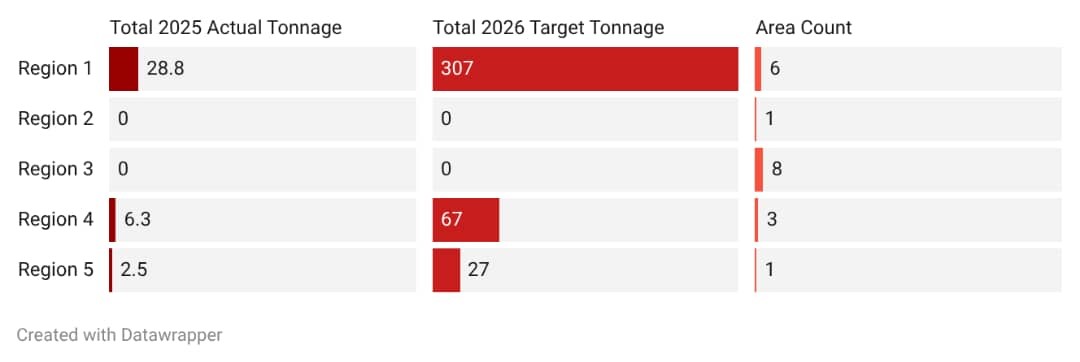
Harare collects half of its targeted refuse annually. Source: Harare City Council.
That is enough rubbish to fill thousands of refuse trucks annually or bury entire neighbourhoods under layers of discarded plastic, food waste and construction debris.
The numbers behind the crisis
The city’s ability to collect waste has steadily weakened over the past five years as population growth, urban expansion and rising consumption have increased the volume of refuse generated. In the 1980s, the city collected 80 per cent of refuse.
While waste volumes have continued to rise between 2020 and 2025, collection capacity has not kept pace. Collection has dropped to between 30 and 50 per cent today.
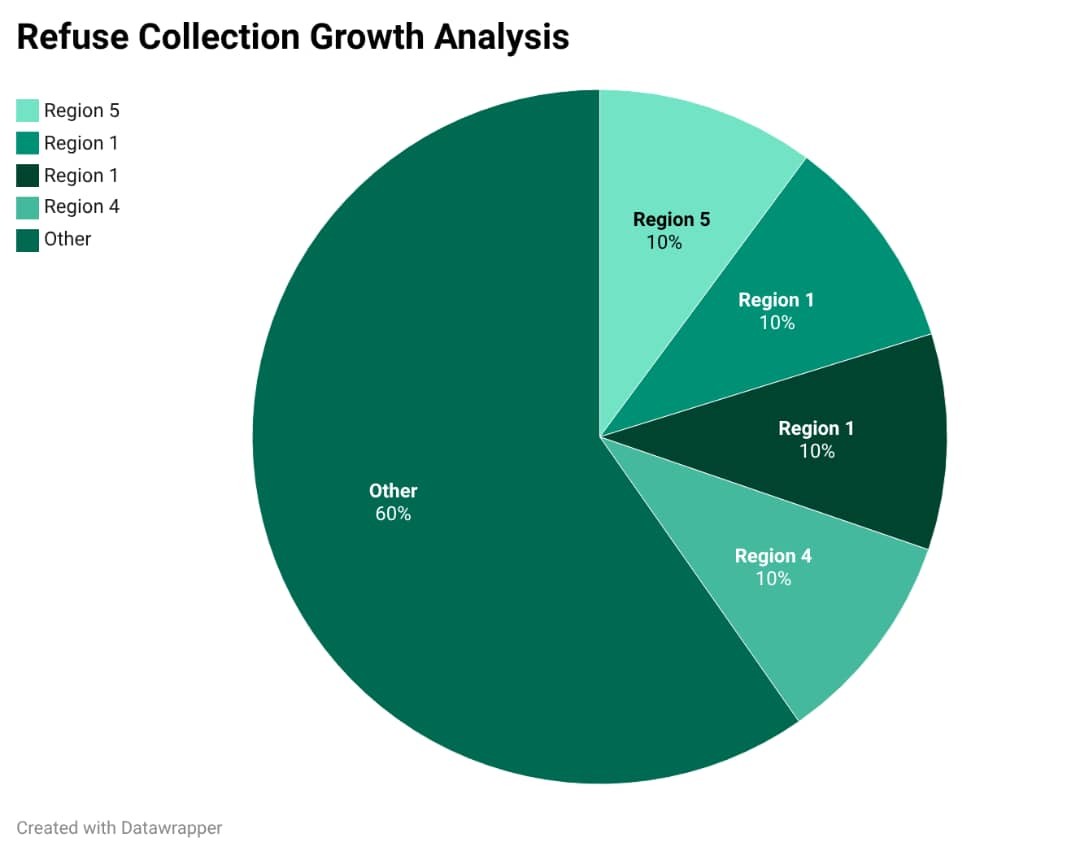
Refuse collection growth analysis in Harare. Source: Geo Pomona Waste Management
The biggest constraint is transport.
Council records reviewed by New Ziana show that Harare currently operates only 33 refuse trucks despite requiring an estimated fleet of about 120 vehicles to provide reliable citywide collection services.
In practical terms, the city is operating with just 27.5 percent of the fleet needed, leaving a deficit of 87 trucks.
The consequences are visible across many high-density suburbs, where refuse often remains uncollected for days or weeks.
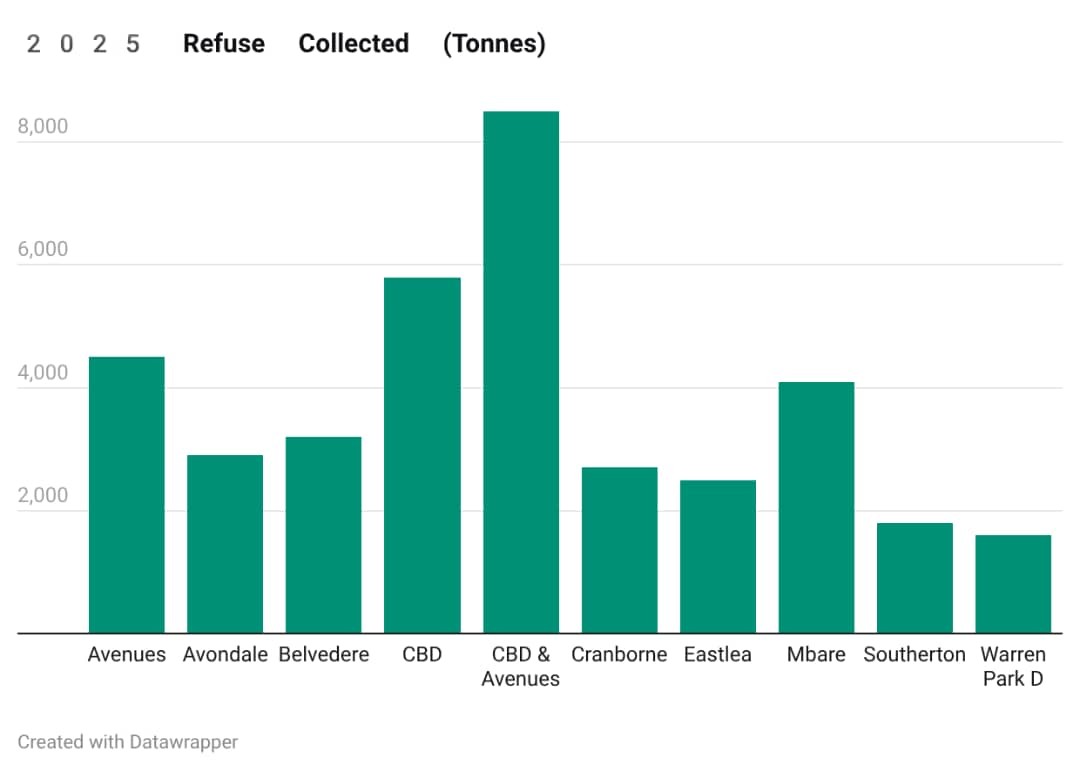
Due to a shortage of trucks, refuse concentration continues unabated in Harare. Source: Geo Pomona Waste Management.
Waste hotspots emerge
Data supplied by Geo Pomona Waste Management identifies Mbare, Glen View, Budiriro, Mabvuku and parts of the central business district as areas experiencing some of the highest levels of waste accumulation.
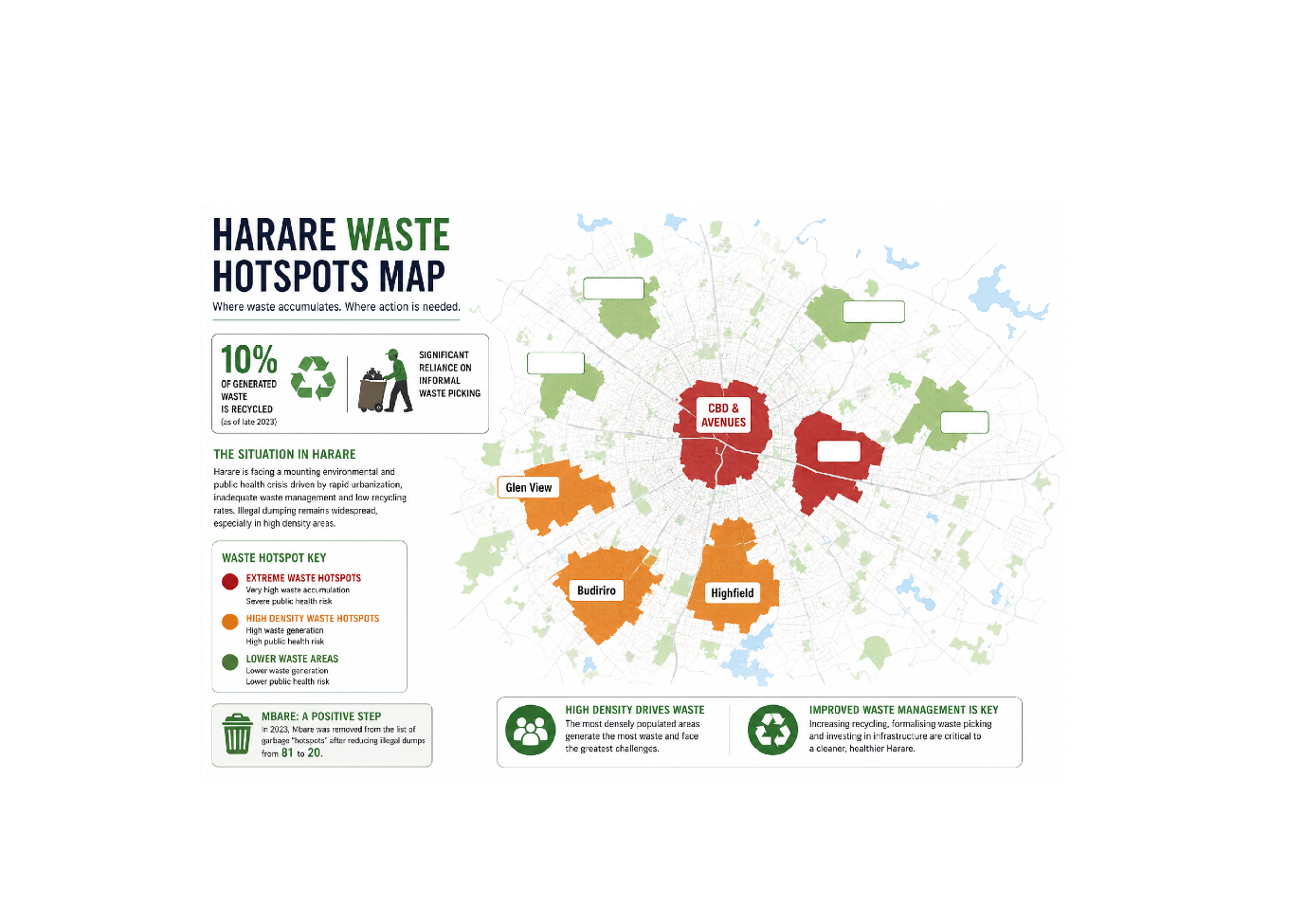
Harare waste hotspots: Mbare, Glen View, Budiriro, Mabvuku and parts of the central business district. Source: Geo Pomona Waste Management
The mapping data reveals a pattern repeated across the city: neighbourhoods with the highest population densities tend to experience the most persistent waste build-up.
The analysis also shows significant disparities in collection services between suburbs. Low-density areas generally receive more frequent collections than densely populated communities where waste generation is highest.
Public health risks grow
Health experts warn that poor waste collection creates conditions that can contribute to disease outbreaks, particularly during the rainy season.
Harare City Council Director of Health Services Dr. Prosper Chonzi said the risks multiply when refuse accumulation combines with sewage leaks and inadequate sanitation.
“When waste services break down, conditions become more favourable for the spread of disease,” he said.
A May 2025 health report reviewed by New Ziana highlighted sanitation-related pressures in clinics serving densely populated suburbs where diarrhoeal illnesses frequently rise during periods of poor environmental conditions.
For Mercy Tobaiwa, a resident of Mabvuku, the statistics are deeply personal.
“I didn’t sleep last night. My baby’s stomach was bloated and he couldn’t stop vomiting,” she said after another visit to a local clinic.
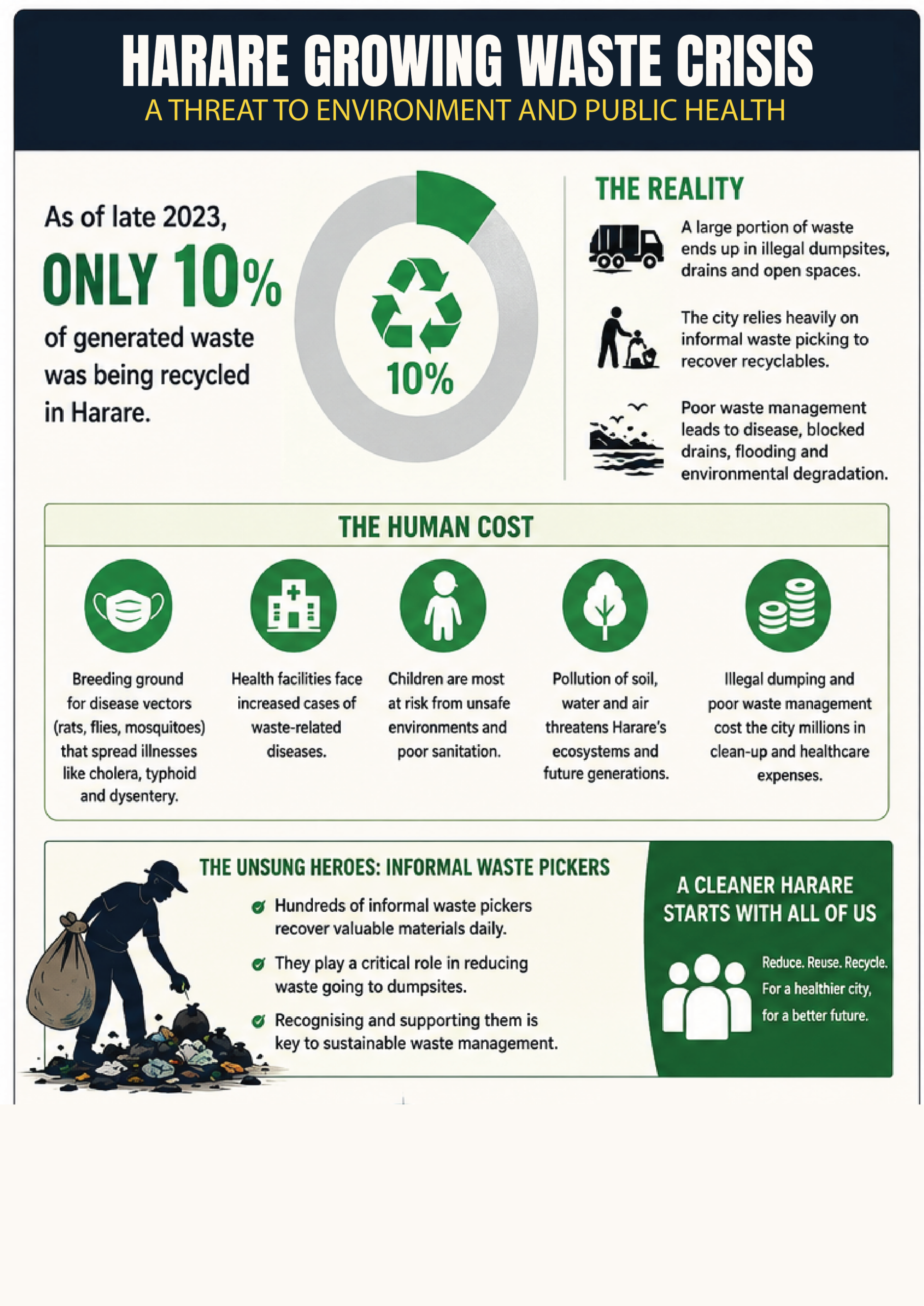
Poor waste collection creates conditions for disease outbreaks. Source: Harare City Council.
Residents demand action
“When trucks don’t come, people have nowhere to put the rubbish,” said another Mabvuku resident, James Tofa.
“It ends up in drains, open spaces and along roadsides.”
Residents’ groups say years of underinvestment in municipal infrastructure have left the city unable to keep pace with growing demand.
“The root of this problem runs deep,” said Precious Shumba, director of the Harare Residents Trust.
“Without adequate investment in infrastructure and service delivery, residents continue to suffer.”
Council cites financial constraints
City officials acknowledge the scale of the challenge but argue that financial pressures have limited their ability to improve services.
Acting Harare Town Clerk Warren Chiwawa said the municipality was operating under difficult economic conditions.
“The city council has been doing its best to manage waste, but we have been facing financial challenges,” he said.
The municipality says it is implementing an Integrated Solid Waste Management Plan aimed at addressing equipment shortages, illegal dumping and the absence of a modern engineered landfill.
Acting Harare City Council Amenities Manager Engineer Keith Mapunzamoyo said reducing the volume of waste sent to disposal sites remains critical.
“We must minimise the amount of waste we dispose of and always strive to reuse or recover,” he said.
Can partnerships solve the problem?
In 2022, Harare entered into a public-private partnership with Geo Pomona Waste Management to support a waste-to-energy project designed to process up to 12,000 tonnes of waste annually.
Supporters say the project could modernise waste management and reduce pressure on existing disposal facilities.
However, data reviewed by New Ziana suggests that collection challenges remain widespread, particularly in suburbs identified as waste hotspots.
Whether the partnership will significantly improve collection rates remains uncertain.
A growing pile and an uncertain future
Back in Mbare, Gwati pauses after sweeping another heap of rubbish into a pile beside the road.
The corner where residents dump waste has grown into a small hill of plastic, cardboard and rotting food.
She points towards it and shakes her head.
“Tomorrow it will be bigger,” she says.
Until Harare closes the widening gap between the waste it generates and the waste it collects, residents will continue paying the price through polluted neighbourhoods, blocked drainage systems, environmental degradation and more public health risks.
For now, the rubbish keeps coming faster than the trucks.