By Thabisani Dube
Harare – The Government of Zimbabwe says it has made significant progress in community reintegration and psychosocial support for people recovering from drug and substance abuse, while introducing new measures to expand free rehabilitation services and vocational training.
During the first quarter of 2026, 382 individuals were successfully reintegrated into their families and communities following treatment and rehabilitation, according to the Ministry of Public Service, Labour and Social Welfare. The national toll‑free hotline, 406, handled 520 case‑managed calls, reflecting growing public trust in government support systems.
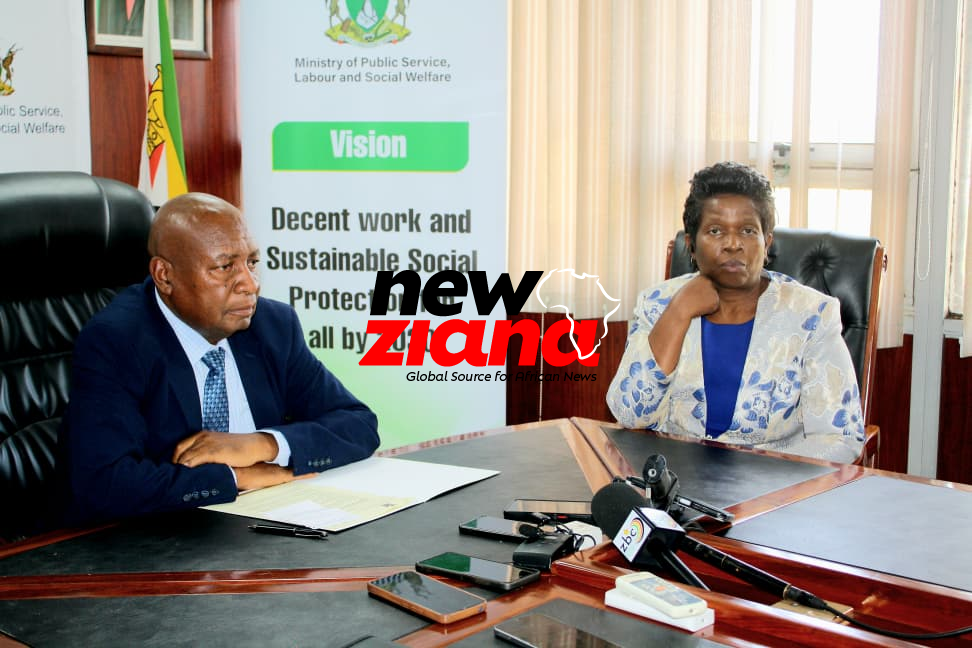
“We remain steadfast in our commitment to addressing the complex challenge of drug and substance abuse through a people‑centred approach that prioritises recovery, dignity and social inclusion,” said Edgar Moyo, Minister of Public Service, Labour and Social Welfare.
Responding to journalists’ questions on unemployment and relapse risks, Moyo stressed the importance of parental guidance and skills training. He said the Ministry is working with the Ministry of Higher and Tertiary Education, Innovation, Science and Technology Development, to identify skills gaps and channel youths into vocational institutions.
Addressing concerns over affordability, Moyo acknowledged that private rehabilitation centres remain costly but confirmed that government is constructing district‑level centres to provide free services.
“Every district should have at least one rehabilitation centre. Those ones will not be expensive, because they are government‑funded,” he said.
Director for Disability Affairs, Laizah Chourombo, added that survivors will be linked to vocational training after detoxification, with plans to provide start‑up kits to help them launch income‑generating projects.
She noted that drug abuse is most rampant in urban areas such as Mbare and Mkoba, though rural communities are also affected.
On whether prevention is better than cure, Moyo reinforced the message, saying awareness campaigns, church involvement, and positive parenting are key to prevention.
“We need responsible parents who follow up on their children and guide them properly. Prevention must begin at home and in the community,” he said.
Deputy Director for Drug and Substance Abuse, Fanuel Dzoma, added that the Ministry is working with that of Sports, Recreation, Arts and Culture to expand safe recreation facilities and with Empower Bank to provide youth loans for small projects.
Through partnerships with organisations such as Mubatirapamwe, Connect, and the Zimbabwe Civil Liberties and Drug Network, the Ministry reached 995 clients in the quarter. At its March inaugural caregiver support meeting, Mubatirapamwe drew 150 caregivers and representatives from the National Technical Committee on Drug and Substance Abuse.
Moyo said the Government will continue to expand community‑based rehabilitation models, strengthen awareness campaigns, and collaborate with civil society, faith‑based organisations, and local communities.
“Our holistic approach embeds sustainable social protection and creates pathways to decent work for rehabilitated individuals, fostering stronger families, resilient communities and a healthier nation,” he added.